USAID DEC
Toward Eliminating Hunger, Malnutrition and Poverty in Niger | Whole-System-in-the-Room Workshop | December 2017
Sign inFAO
Toward Eliminating Hunger, Malnutrition and Poverty in Niger | Whole-System-in-the-Room Workshop | December 2017
The United States Government (USG) agencies, including the United States Agency for International Development (USAID), the U.S.
2017 · 44 pages
Sign in to readA free account is required to download.
Abstract
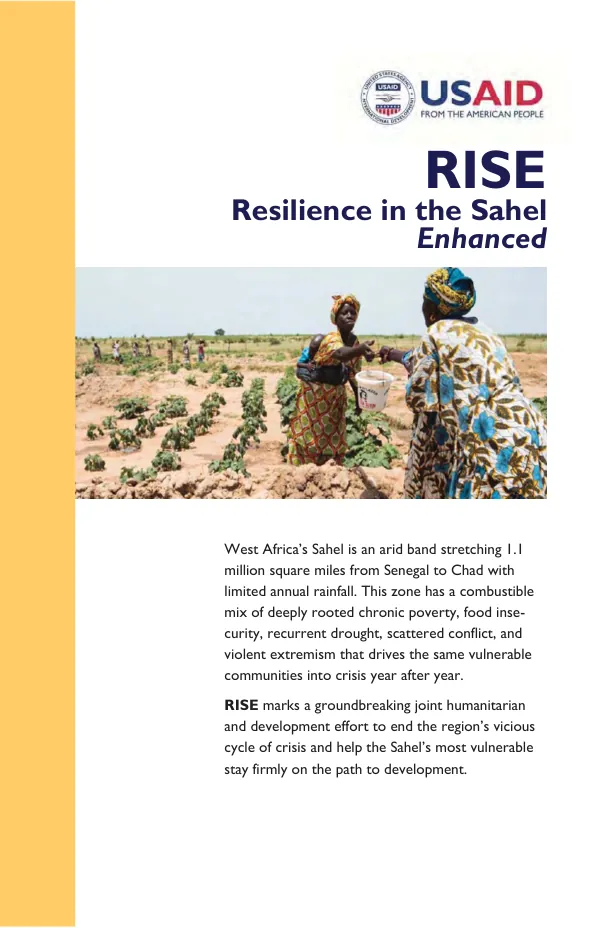
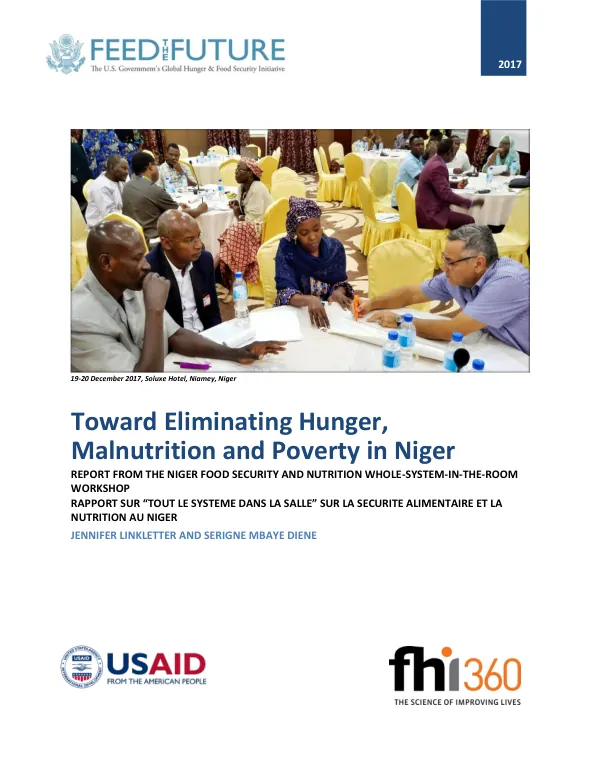
African Development Fund (USADF), and the Millennium Challenge Corporation (MCC), have been working with the Government of Niger (GoN) and other partners to address household hunger, acute malnutrition, chronic poverty, and persistent vulnerability in Niger. These efforts have been ongoing for the past five years through various programs. One such program is the Resilience in the Sahel Enhanced (RISE) initiative, a three-year program that provides humanitarian development assistance to promote resilience in agro-pastoral communities and marginal agriculture livelihood zones in Niger and Burkina Faso. RISE has three key programs: Resilience and Economic Growth in the Sahel - Accelerated Growth (REGIS-AG), which strengthens value chains and improves incomes for vulnerable populations; Resilience and Economic Growth in the Sahel- Enhanced Resilience (REGIS-ER), which fortifies communities against shocks and stresses through sustainable livelihoods, natural resource management, governance, and health interventions; and the Sahel Resilience Learning Project (SAREL), which emphasizes capacity building of stakeholders to use evidence-based learning and adopt effective methods and innovations to improve resilience in the region. RISE II, the continuation of RISE, will extend programming another five years in Niger and Burkina Faso starting in 2018. In 2017, Niger was chosen to be part of the USG Global Food Security Strategy (GFSS) for the first time, making it one of twelve Feed the Future target countries around the world. The target countries are currently in the strategic planning phase, developing a whole-of-government country plan for achieving the goals of the GFSS through country action plans. From December 19 to 20, 2017, USAID convened 88 participants, one-third of whom were women, from six diverse food security and nutrition stakeholder groups, including agencies from the USG active in Niger. The purpose of the meeting was to articulate how the Feed the Future GFSS country plan can complement the ongoing work of the GoN and other actors, and to allow key stakeholders in Niger to provide input on the country plan. The meeting brought together representatives from various stakeholder groups, including the GoN, USG agencies, non-governmental organizations (NGOs), and civil society organizations (CSOs). The participants discussed the challenges of household hunger, acute malnutrition, chronic poverty, and persistent vulnerability in Niger, and explored ways to address these challenges through the Feed the Future GFSS country plan. The meeting resulted in a number of key recommendations and action items, which are outlined in Annex 1 of the report. These recommendations and action items focus on areas such as improving agricultural productivity, enhancing market access, and strengthening nutrition and health services. The report also highlights the importance of continued collaboration and coordination among stakeholders to achieve the goals of the Feed the Future GFSS country plan. The Global Food Security Strategy (GFSS) aims to reduce hunger and malnutrition in Niger by improving agricultural productivity, enhancing market access, and strengthening nutrition and health services. The GFSS country plan for Niger is being developed through a whole-of-government approach, involving the Government of Niger, USG agencies, NGOs, and CSOs. The GFSS country plan for Niger focuses on several key areas, including: 1. Improving agricultural productivity through the use of improved seeds, fertilizers, and irrigation systems. 2. Enhancing market access through the development of rural roads, storage facilities, and market information systems. 3. Strengthening nutrition and health services through the provision of micronutrient supplements, deworming medication, and health education. The GFSS country plan for Niger also emphasizes the importance of continued collaboration and coordination among stakeholders to achieve its goals. This includes the need for the Government of Niger to take a lead role in implementing the plan, and for USG agencies and other partners to provide technical assistance and support. The GFSS country plan for Niger is expected to be completed in 2018, and will be implemented over a period of five years. The plan will be monitored and evaluated regularly to ensure that it is meeting its goals and objectives.
Related documents