USAID DEC
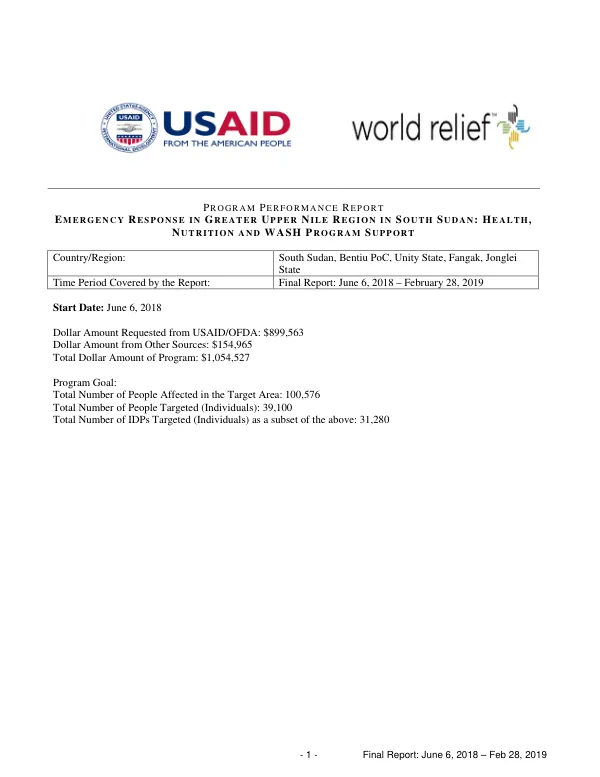
Final Report: Emergency Response in Greater Upper Nile Region in South Sudan: Health, Nutrition and WASH Program Support
Sign inMÉDECINS SANS FRONTIÈRES
Final Report: Emergency Response in Greater Upper Nile Region in South Sudan: Health, Nutrition and WASH Program Support
The emergency response in the Greater Upper Nile Region in South Sudan, led by World Relief South Sudan (WRSS), aimed to address the health, nutrition, and water, sanitation, and hygiene (WASH) needs of affected populations.
2019 · 14 pages
Sign in to readA free account is required to download.
Abstract
The program targeted 100,576 individuals, with a focus on 39,100 individuals, including 31,280 internally displaced persons (IDPs). WRSS implemented nutrition activities in eight sites, including Wichmon, Boam, Kuemduok, Koatnyakoang, Tiep, and Bei in Fangak County, and Sector 2 and Sector 5 in Bentiu PoC. The program focused on outpatient therapeutic programs (OTP), therapeutic feeding programs (TFSP), and infant and young child feeding (IYCF) activities. Staff and volunteer capacities were strengthened to provide quality management of acute malnutrition services. The program experienced challenges, including the relocation of staff due to local authorities' demands for taxes and fees, seasonal flooding in Fangak County, and a shortage of nutrition supplies. However, WRSS advocated with local authorities and partners to regain access for relocateable staff and restored pipelines for nutrition supplies. WRSS also implemented health activities in Bentiu PoC Sector 2 and Fangak, including antenatal care, deliveries, postnatal care, and curative consultations for common conditions. The program employed relocatable staff to ensure quality service delivery and built the capacity of locally recruited staff through on-the-job training. Key indicators for the nutrition sector showed significant achievements, including a 67.4% proportion of infants 0-5 months of age who were fed exclusively with breast milk, and a 68,973 number of people receiving behavior change interventions to improve infant and young child feeding practices. The program also reported a 96.8% cure rate for malnutrition cases, with an average length of stay of 5 weeks. In the health sector, WRSS implemented maternal and child health messages, disseminated by Home Health Promoters and Community Health Workers. The program also provided health education messages on various topics, including prevention of malaria, acute watery diarrhea, and eye and skin infections. Pregnant women were sensitized on the importance of attending antenatal care, choosing health facilities for delivery, and exclusive breastfeeding. The program's geographic focus was on the Greater Upper Nile Region in South Sudan, with a specific emphasis on Bentiu PoC and Fangak County. The timeframes for the program were from June 6, 2018, to February 28, 2019. The program's total dollar amount was $1,054,527, with $899,563 requested from USAID/OFDA and $154,965 from other sources. WRSS participated in various nutrition coordination meetings with SMOH, UNICEF, OCHA, and other nutrition partners. The program also introduced Early Childhood Development (ECD) activities at the nutrition centers and in the community, further integrating services and catalyzing funding.
Related documents