USAID DEC
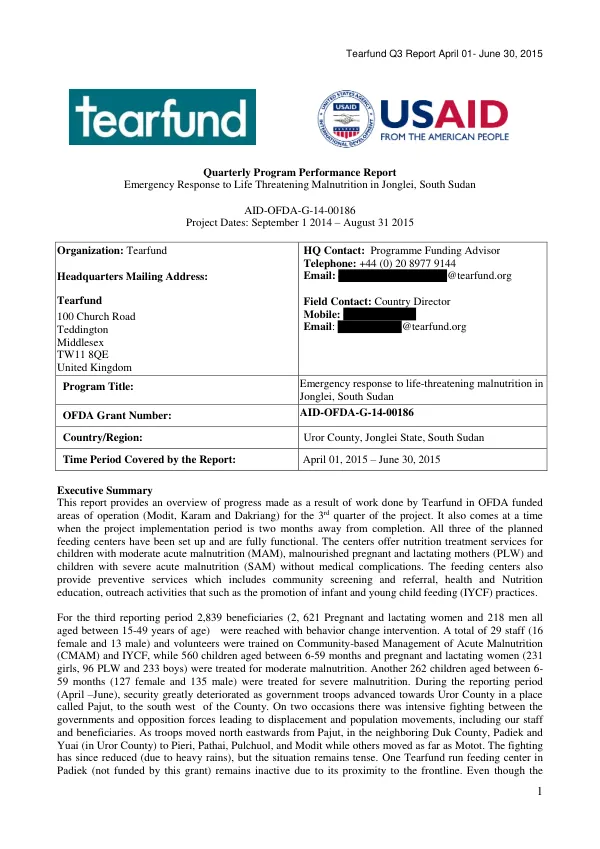
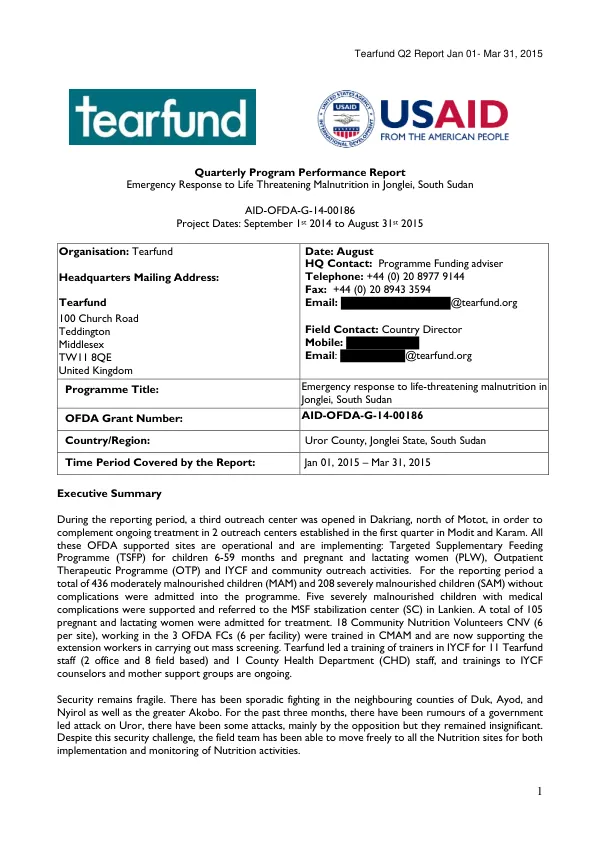
Quarterly Program Performance Report: Emergency Response to Life Threatening Malnutrition in Jonglei, South Sudan
Sign inCARE
Quarterly Program Performance Report: Emergency Response to Life Threatening Malnutrition in Jonglei, South Sudan
The Emergency Response to Life-Threatening Malnutrition in Jonglei, South Sudan, is a program implemented by Tearfund, a UK-based organization, with funding from the United States Agency for International Development (USAID) through the Office of U.S.
2015 · 9 pages
Sign in to readA free account is required to download.
Abstract
Foreign Disaster Assistance (OFDA). The program aims to address the critical issue of malnutrition in Jonglei State, particularly in Uror County, where the population is heavily affected by conflict and food insecurity. During the reporting period of January 1 to March 31, 2015, a third outreach center was established in Dakriang, north of Motot, to complement the existing two centers in Modit and Karam. All three centers are operational and implementing the Targeted Supplementary Feeding Programme (TSFP) for children 6-59 months and pregnant and lactating women (PLW), Outpatient Therapeutic Programme (OTP), and Infant and Young Child Feeding (IYCF) activities. A total of 436 moderately malnourished children and 208 severely malnourished children without complications were admitted into the program during the reporting period. The program also focused on IYCF and community outreach activities, with a total of 105 pregnant and lactating women admitted for treatment. Community Nutrition Volunteers (CNV) were trained in Community Management of Acute Malnutrition (CMAM) and are supporting extension workers in carrying out mass screening. Tearfund also led a training of trainers in IYCF for 11 staff members and 1 County Health Department (CHD) staff, and trainings to IYCF counselors and mother support groups are ongoing. Security remains a major concern in the area, with sporadic fighting in neighboring counties and rumors of a government-led attack on Uror. Despite this, the field team has been able to move freely to all the nutrition sites for implementation and monitoring of nutrition activities. Tearfund continues to monitor its security indicators closely and updates its security plan every quarter to minimize risk in case of active fighting. The program has made significant progress in addressing malnutrition in the area. A total of 661 children 6-59 months benefited from the TSFP program, with 216 children discharged and 91.7% cured. Among the discharged children, 0% died, 6.5% defaulted, 0.5% were non-responders, and 1.4% were transferred to Outpatient Therapeutic Care (OTP). The program also reached 105 malnourished PLWs, with 61 pregnant and 44 lactating women admitted for TSFP treatment. However, the program faced challenges in managing severe acute malnutrition (SAM), with a breakage in the WFP pipeline for supplies to treat PLWs with MAM causing the program to focus on children only. The program also faced difficulties in referring children with SAM complications to the stabilization center in Lankien due to access and resource constraints. As a result, Tearfund plans to use resources budgeted for staff and supplies at a stabilization center to cover the increase in the number of extension workers to 7 from 4 at the 3 outreach centers to meet the caseload. In conclusion, the Emergency Response to Life-Threatening Malnutrition in Jonglei, South Sudan, is a critical program that aims to address the issue of malnutrition in the area. Despite the challenges faced by the program, significant progress has been made in addressing malnutrition, and the program continues to work towards its goals of improving the health and well-being of the population in Jonglei State.