USAID DEC
Final Report: Examinining Gender-Based Violence and Women's Economic Empowerment in Environmental Contexts
Sign inBANYAN GLOBAL
Final Report: Examinining Gender-Based Violence and Women's Economic Empowerment in Environmental Contexts
Gender-based violence (GBV) affects all communities, cutting across contexts and impacting all sectors.
2024 · 21 pages
Sign in to readA free account is required to download.
Abstract
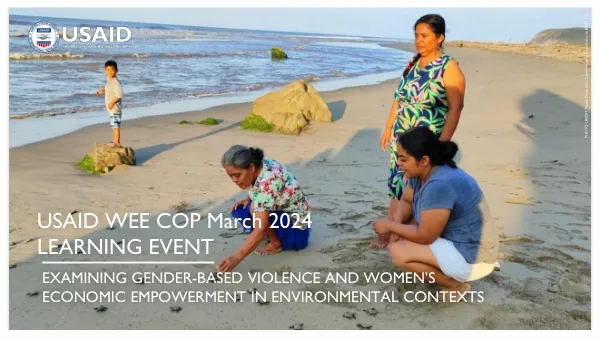
GBV is used to negotiate and reinforce existing privileges and power imbalances in access and control of natural resources. These dynamics are exacerbated in the face of climate change and environmental degradation and threats. GBV is used to shape and control environmental work and environmental defense, silencing women and discouraging their engagement in environmental activities, jobs, and leadership. GBV is a threat to women's economic empowerment (WEE), as it bars women's roles in environmental livelihoods and hinders their ability to safely decide how income from environmental livelihoods is used. Sexual extortion is a reality women face to gain access to environment-related jobs and income. WEE, together with GBV prevention and mitigation, is essential for environmental livelihoods. WEE is important to address vulnerability to GBV both at home and in environmental work. All WEE activities should account and address GBV risks. GBV affects women's ability to engage in environmental jobs and livelihood opportunities. A 2020 survey of 980 women in ocean science found that 78% of respondents experienced sexual harassment in the marine science workplace and learning environments. A 3-year study of 5,300 women engineers found that 38% left or never started STEM jobs, with sexual harassment and violence identified as a key contributor. Examples of challenges include the Chittagong Hill Tracts of Southeast Bangladesh, where over 45% of women report facing GBV at their workplaces, while 44% are subjected to domestic abuse and 61% experience GBV at marketplaces. In Mexico, a group of women ran a small fruit and firewood plantation on a plot they leased from the communal agrarian authority, but the plot was burned down by men, signaling disapproval of the initiative. The establishment of another women's collective plantation was never discussed again, and there was no ability to establish another source of firewood near the residential area. A woman and a man were selected from a rural village to attend a training on manual drilling in a neighboring district. The woman attended the training and participated fully, but when she returned to her village, she faced unpleasant rumors that she had had sexual relations with men while she was away. The RISE grants challenge aims to address GBV issues and solutions specific to sex-for-fish, sexual harassment, and harmful organizational culture. The challenge seeks to support projects that promote WEE and address GBV risks in environmental livelihoods. The International Union for Conservation of Nature (IUCN) is working to address GBV in environmental contexts, recognizing that GBV is a threat to WEE and environmental sustainability. By addressing GBV, WEE, and environmental livelihoods, it is possible to promote sustainable development and human rights.
Related documents