USAID DEC
Synthesis of Data Collected From Health Facilities through Supportive Supervision – HSFR/HFG Project Year 1 (2013/14)
Sign inABT ASSOCIATES
Synthesis of Data Collected From Health Facilities through Supportive Supervision – HSFR/HFG Project Year 1 (2013/14)
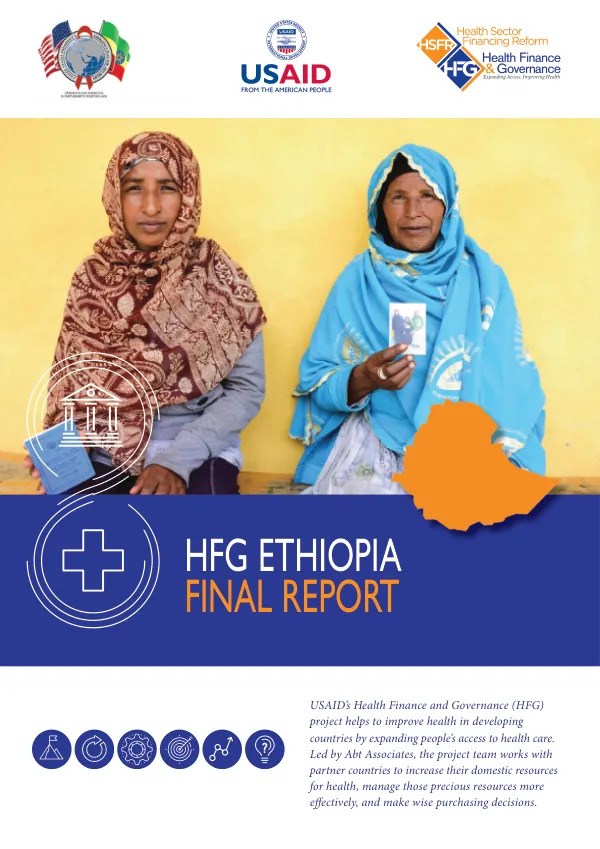
The Health Finance and Governance Project, led by Abt Associates, aims to improve health in developing countries by expanding people's access to healthcare.
2016 · 88 pages
Sign in to readA free account is required to download.
Abstract
The project team works with partner countries to increase their domestic resources for health, manage those resources more effectively, and make wise purchasing decisions. As a result, the five-year, $209 million global project increases the use of both primary and priority health services, including HIV/AIDS, tuberculosis, malaria, and reproductive health services. The project's focus is on fundamentally strengthening health systems, supporting countries as they navigate the economic transitions needed to achieve universal healthcare. In Ethiopia, the project is implemented through the Health Sector Financing Reform/Health Finance and Governance (HSFR/HFG) project, which is funded by the United States Agency for International Development (USAID). The HSFR/HFG project conducts supportive supervision in health facilities to assess their financial management and governance practices. The project's methodology involves regular quarterly visits to health facilities, where data is collected on various aspects of health facility finance and governance. The data is then analyzed to identify areas of strength and weakness, and recommendations are made to improve health facility finance and governance practices. The project's findings indicate that health facilities in Ethiopia face significant challenges in terms of financial management and governance. Many health facilities have inadequate financial management systems, leading to poor financial performance and limited access to healthcare services. The project's data also shows that health facilities have limited capacity to manage their finances effectively, with many facilities relying on external support to manage their finances. The project's analysis of health facility finance and governance practices reveals several key findings. Firstly, health facilities in Ethiopia have limited capacity to manage their finances effectively, with many facilities relying on external support to manage their finances. Secondly, health facilities have inadequate financial management systems, leading to poor financial performance and limited access to healthcare services. Thirdly, health facilities have limited capacity to make wise purchasing decisions, leading to inefficient use of resources. The project's recommendations for improving health facility finance and governance practices include strengthening health facility financial management systems, improving health facility governance practices, and increasing the capacity of health facilities to make wise purchasing decisions. The project also recommends that health facilities should prioritize the use of retained revenue to improve healthcare services, and that user fees should be set and revised in a transparent and accountable manner. The project's findings and recommendations are based on data collected from health facilities through supportive supervision, and are intended to inform policy and programming decisions at the national and sub-national levels. The project's ultimate goal is to improve health outcomes in Ethiopia by strengthening health systems and increasing access to healthcare services.