FHI 360
Final Report: Integrated Humanitarian Assistance to Yemen
The Integrated Humanitarian Assistance to Yemen (IHAY) project, implemented by FHI 360, aimed to provide comprehensive support to host communities and internally displaced persons (IDPs) in Yemen.
2018 · 25 pages
Sign in to readA free account is required to download.
Abstract
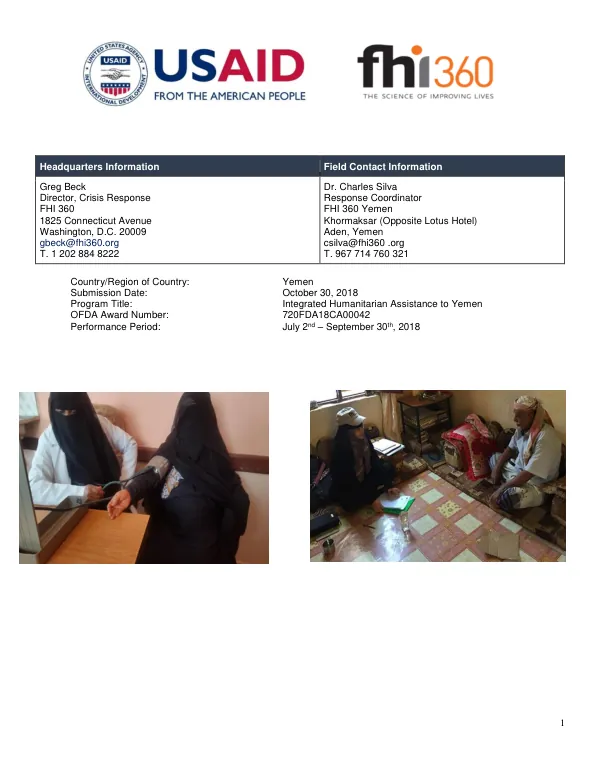
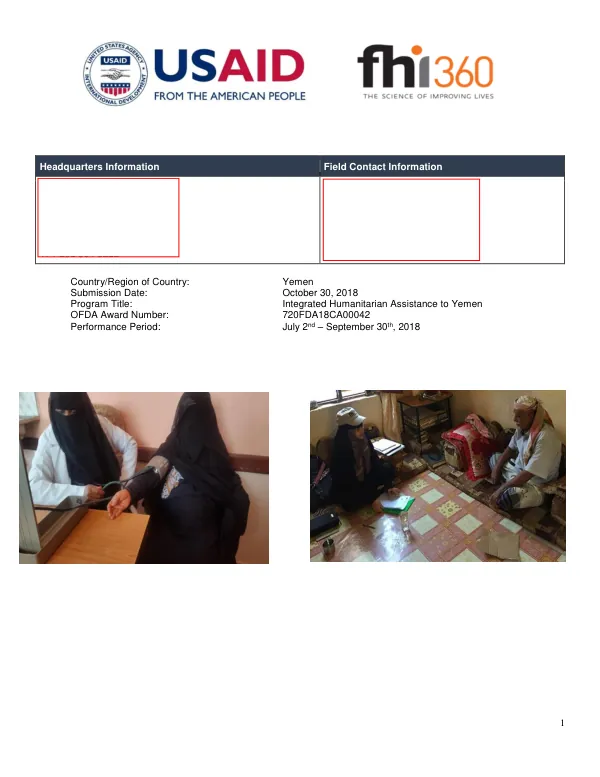
The project focused on health, nutrition, and water, sanitation, and hygiene (WASH) activities in three sites along the Western Coast of Yemen: Mokha, Dhubab, and Khokha. FHI 360 conducted a comprehensive needs assessment on the Western Coast, identifying and selecting three health facilities for support: Khokha MCH, Al Ghaded HC, and Mokha MCH. The health facilities were found to be partially functioning with limited health services, and Al Ghaded Health Center was partially damaged due to the war. To improve access to health services and restore full operations in these health facilities, FHI 360 supplied 24 Integrated Emergency Health Kits (IEHK) and 4 Basic Health Kits (BHK) to Mokha and Khokha MCHs. FHI 360's health staff provided case management for communicable and non-communicable diseases, and maternal and child healthcare, including deliveries, in Khokha and Mokha MCHs. During the reporting period, the health staff managed approximately 10,210 patients, which constitutes 15% of the target population. The health staff also provided antenatal care to 286 women, assisted in deliveries for 168 pregnant women, and provided postnatal care for 207 newborns. In addition to health services, FHI 360 supported the Outpatient Therapeutic Program (OTP) in Khokha, providing Plumpy'nut Ready-to-Use Therapeutic Food (RUTF) to 150 boxes of children suffering from severe acute malnutrition (SAM). FHI 360 health staff conducted MUAC screening for 289 children (6-59 months) out of a total planned target population of 22,433 children with SAM. FHI 360 also collected detailed baseline information focusing on water supply, sanitation, and health care waste management conditions at the three targeted health facilities. Informed by the findings, FHI 360 is finalizing preparations and adaptations of design documents for submission to OFDA for technical review in the next reporting period. The project aimed to improve access to critical healthcare services in conflict-affected and displaced communities, improve the nutritional status of vulnerable groups, and contribute to reduced morbidity and mortality arising from WASH-related diseases. FHI 360 is fully operational and providing primary health care and reproductive health services in two health facilities, Khokha and Mokha MCHs, with a target population of 24,852, including 4,200 IDPs. FHI 360 has established coordination with the Ministry of Public Health and Population (MoPHP) and is actively engaged with the health and nutrition cluster coordination mechanisms. The project has also incentivized the MoPHP health and nutrition staff from Mokha and Khokha to encourage them to provide health services. As a preventative measure in anticipation of a potential third wave outbreak of Cholera, FHI 360 will conduct an in-depth Cholera risk situational assessment at the supported health facilities. The project's progress against planned objectives, activities, and indicators from July 2nd to September 30th, 2018, is captured in this report. FHI 360's Health, Nutrition, and WASH activities comprise a fully integrated package to promote comprehensive support to host communities and IDPs, thus reducing risks of morbidity and mortality and contributing to improved wellbeing of displaced and conflict-affected individuals.
Related documents