USAID DEC
Strengthening Family Planning Services in Yemen: Annual Report August 27th, 2018 – September 30th, 2019
Sign inMINISTRY OF HEALTH AND POPULATION
Strengthening Family Planning Services in Yemen: Annual Report August 27th, 2018 – September 30th, 2019
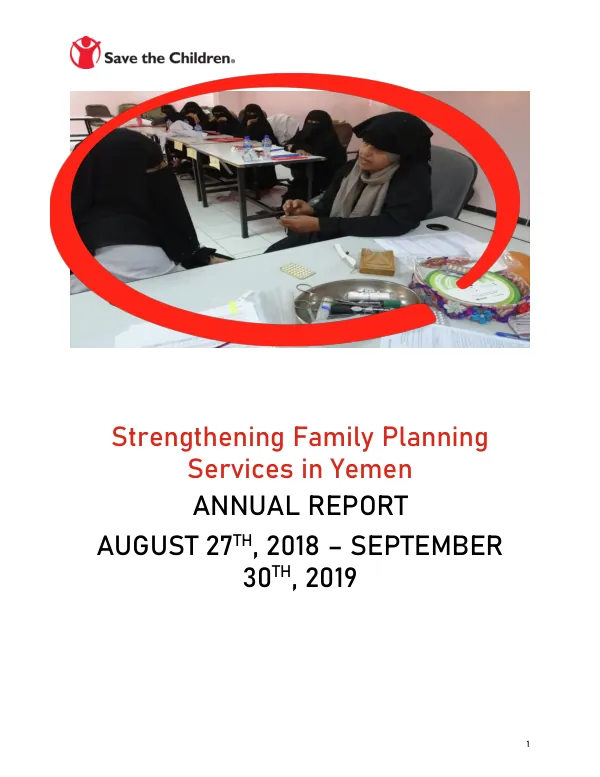
Strengthening Family Planning Services in Yemen is a USAID-funded project implemented by Save the Children, with the goal of increasing provision of family planning services among conflict-affected women and girls accessing hospitals and health centers in six governorates.
2019 · 17 pages
Sign in to readA free account is required to download.
Abstract
The project began in August 2018 and will be implemented for a two-year period. The project work plan, covering the period from August 28, 2018 to September 30, 2019, was submitted to USAID on October 26, 2018 and was approved in February 2019. The Monitoring and Evaluation plan was approved by USAID on March 7, 2019. Save the Children has signed an initial Memorandum of Understanding (MoU) with the Southern government on January 28, 2019, and the final approval from the Ministry of Planning and International Cooperation (MoPIC) and the Ministry of Public Health and Population (MoPHP) was signed on June 12, 2019. The project is working in six governorates, including Aden, Amran, Lahj, Hajjah, Hodeida, and Sa'ada, with a focus on increasing provision of family planning services among conflict-affected women and girls. The project has secured year one approval from USAID for the work plan, Emergency Medical Management Plan (EMMP), and Monitoring and Evaluation (M&E) plans covering work in six governorates. Despite delays in project approval, the project has made significant progress in the South. The project secured initial approval from MoPIC (South) in January 2019, and the final approval was received in June 2019. The project has also secured approval from the Ministry of Public Health and Population (MoPHP) North, and has started field activities according to the approved work plan. The project has identified a list of 220 health facilities to be supported for year two of the project, and has finalized a detailed health facility assessment for 24 health facilities in Lahj and Aden. The project has also completed two family planning service provision assessments involving 26 midwives from 14 health facilities at Aden and Lahj. In collaboration with the South MoPHP, the project has identified a list of DHOs' supervisors to be trained as trainers of trainers (TOTs) on supply chain, health information systems, infection prevention, and supportive supervision. These supervisors will work on providing monthly supportive supervision to the health facilities to ensure quality of care and FP compliance requirements. Due to delays in project approval, 300,000 strips of Combined Oral Contraceptives (COCs) reached six months within their expiration date, and MoPHP decided that the project should not distribute but rather destroy them. Save the Children is working with USAID and local government to identify a better plan to dispose of these commodities. The project has also secured approval from USAID to conduct minor rehabilitation for SCI Taiz warehouse, GHO Lahj and Aden warehouses, and Training centers, and the rehabilitation process started in September 2019. The project has also finalized a detailed health facility assessment for 24 health facilities in Lahj and Aden, and two family planning service provision assessments involving 26 midwives from 14 health facilities at Aden and Lahj have been completed. In the South, the activities officially started on the ground on June 12th after the final approval from the South government represented by MoPIC (South). The project has also secured approval from MoPHP North, and has started field activities according to the approved work plan. The project has identified a list of 220 health facilities to be supported for year two of the project, and has finalized a detailed health facility assessment for 24 health facilities in Lahj and Aden. The project has also completed two family planning service provision assessments involving 26 midwives from 14 health facilities at Aden and Lahj. In collaboration with the South MoPHP, the project has identified a list of DHOs' supervisors to be trained as TOTs on supply chain, health information systems, infection prevention, and supportive supervision. These supervisors will work on providing monthly supportive supervision to the health facilities to ensure quality of care and FP compliance requirements. The project has