GOVERNMENT OF SENEGAL
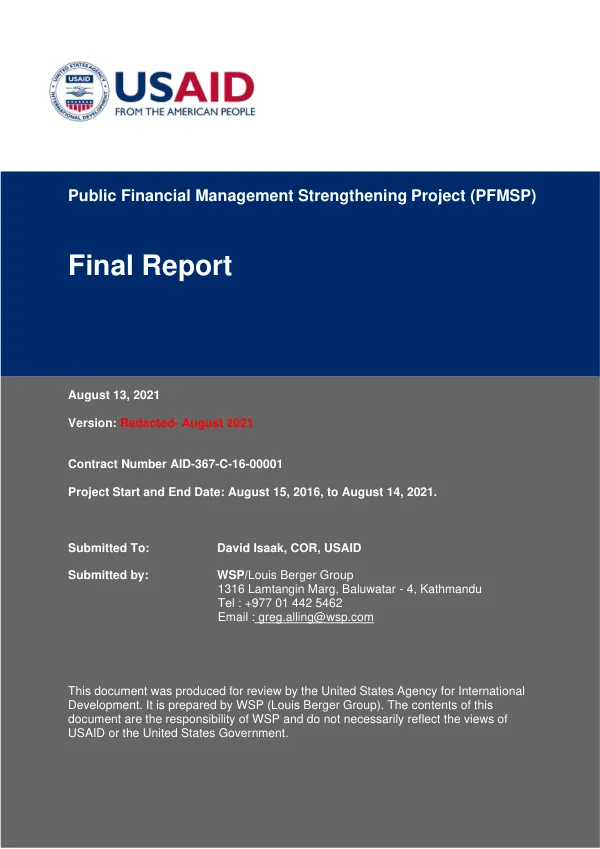
Final Report: Public Financial Management Strengthening Project (PFMSP) in Nepal
The Public Financial Management Strengthening Project (PFMSP) in Nepal began implementation in August 2016 and completed in August 2021.
2021 · 67 pages
Sign in to readA free account is required to download.
Abstract
The five-year, $14.9 million USAID project aimed to improve accountability and transparency in the use of public funds, particularly for grant funds sent from the federal government and funds provided by Development Partners (DPs). The project's implementation was designed to be flexible, given the country's transition from a unitary to a federal system. Nepal's 2015 Constitution, which took effect in 2017, led to a major restructuring of government, with the devolution of powers to 753 local governments (LGs) and seven Provincial Governments (PGs). This devolution resulted in significant changes to the sourcing of public services, including education and health, with grants and revenue transfers from the federal government becoming the primary funding sources for SNGs. Local governments were empowered to plan and expend funds per local needs, led by newly elected officials. The project's implementation was also influenced by the need to modernize bureaucratic systems to better manage public finances. The Government of Nepal (GON), USAID, and other Development Partners recognized the urgent need to improve fiscal accountability, particularly in the context of fiscal federalism. Without new, consistently implemented Public Financial Management (PFM) systems, the country's weak fiscal accountability under the unitary government could worsen. The PFMSP project focused on three key components: Improved Budget Planning and Execution Capacity of the Government of Nepal (IR1), Improved Control Environment and Procurement Capacity in Targeted Ministries and Agencies (IR2), and Strengthened Financial Management Functions of the National Reconstruction Authority (IR3). The project also emphasized Gender Equality and Social Inclusion (GESI) and Gender Responsive Budgeting. The project's implementation was monitored and evaluated through a robust Monitoring, Evaluation, and Learning (MEL) system. Key performance indicators (KPIs) were tracked, and evaluations, surveys, and assessments were conducted to inform project decisions and adapt to changing circumstances. The project also fostered collaboration, learning, and adaptation among stakeholders, including government officials, Development Partners, and civil society organizations. The project's sustainability planning aimed to ensure that the gains made during the project period would be sustained beyond its completion. A sustainability approach was developed, which included recommendations based on lessons learned during the project implementation. The project's final report provides a comprehensive overview of the project's achievements, challenges, and lessons learned, and serves as a valuable resource for future projects and initiatives in Nepal.