USAID DEC
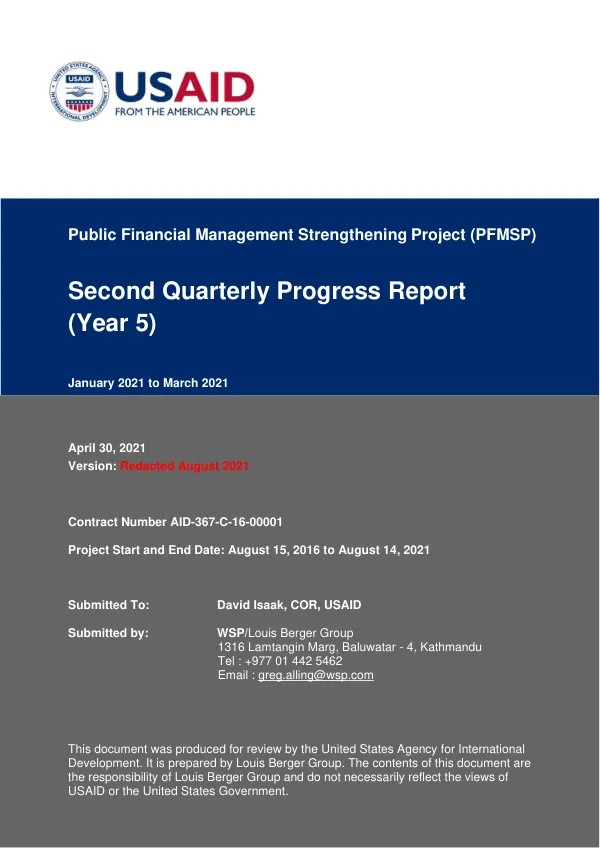
Public Financial Management Strengthening Project (PFMSP) Second Quarterly Progress Report (Year 5)
Sign inGOVERNMENT OF SENEGAL
Public Financial Management Strengthening Project (PFMSP) Second Quarterly Progress Report (Year 5)
The Public Financial Management Strengthening Project (PFMSP) in Nepal has been ongoing since 2016, with the goal of improving the country's public financial management systems.
2021 · 51 pages
Sign in to readA free account is required to download.
Abstract
The project is supported by the United States Agency for International Development (USAID) and aims to strengthen the capacity of the Government of Nepal (GON) to manage public finances effectively. The project has been implemented in a complex context, with Nepal undergoing a major restructuring of government from a Unitary to a Federal System since 2017. This devolution of powers has resulted in the delegation of responsibility for major public services like education and health to sub-national governments, including 753 Local Governments (LGs) and seven Provincial Governments. The GON's Public Financial Management (PFM) reform strategy, systems, mechanisms, and training efforts are now rooted in federalism and tied to the expectation that the system of 761 governments will exist for years to come. However, the country's politics have been unstable, with the dissolution of the House of Representatives in December 2020 and the subsequent invalidation of the Nepal Communist Party (NCP) in March 2021. Despite this uncertainty, the PFMSP has continued to support the GON in its efforts to modernize the bureaucracy and make it more transparent and accountable to its citizenry. The project has focused on improving budget planning and execution capacity, control environment and procurement capacity, and strengthening financial management functions of the National Reconstruction Authority. The project has made significant progress in implementing its activities, including the development of a new strategic plan for PFM reform with shared political will across the three government levels. The Ministry of Finance (MOF) has recognized the need for a new strategic plan, and PFMSP stands ready to provide advisory services if requested. The project has also supported the development of an Integrated Financial Management Information System (IFMIS) to serve all 761 of the country's governments. This system aims to integrate disparate financial management information systems and provide a more comprehensive and transparent view of public finances. The PFMSP has also supported the development of a new Chart of Accounts (COA) and the implementation of a Treasury Single Account (TSA) system. These systems aim to improve the accuracy and transparency of financial reporting and reduce the risk of financial mismanagement. In terms of monitoring and evaluation, the project has established a robust system to track progress and identify areas for improvement. The project has also conducted regular monitoring and evaluation activities to assess the effectiveness of its interventions and identify lessons learned. Overall, the PFMSP has made significant progress in supporting the GON's efforts to strengthen its public financial management systems. Despite the challenges posed by the country's unstable politics, the project has continued to support the development of a more transparent and accountable bureaucracy, and has made significant progress in implementing its activities.
Related documents