USAID DEC
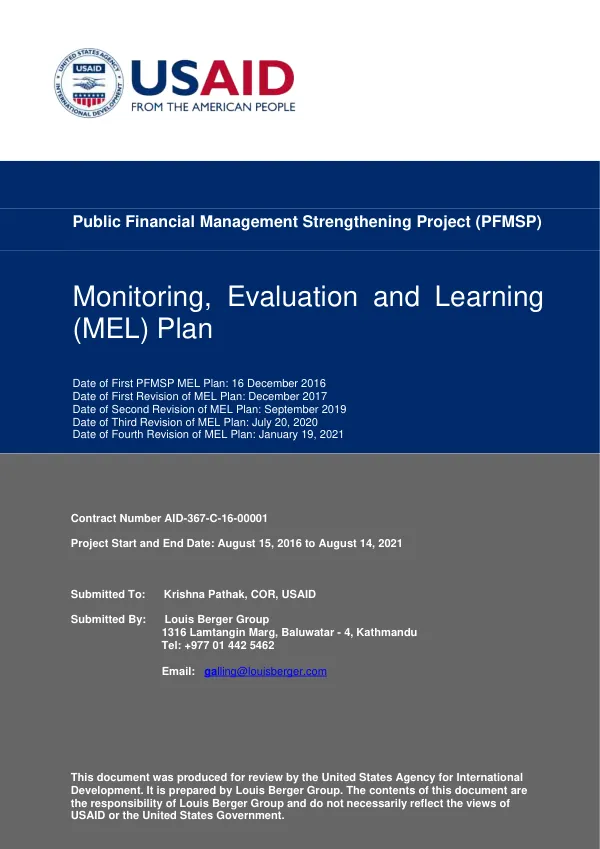
Public Financial Management Strengthening Project (PFMSP) Monitoring, Evaluation and Learning (MEL) Plan
Sign inTHE LOUIS BERGER GROUP, INC.
Public Financial Management Strengthening Project (PFMSP) Monitoring, Evaluation and Learning (MEL) Plan
The Public Financial Management Strengthening Project (PFMSP) in Nepal aimed to improve the country's public financial management systems.
2016 · 264 pages
Sign in to readA free account is required to download.
Abstract
The project began on August 15, 2016, and concluded on August 14, 2021. It was implemented by the Louis Berger Group, with funding from the United States Agency for International Development (USAID). The project's primary objective was to strengthen the capacity of the Government of Nepal (GON) to manage public finances effectively. This involved improving the financial management information system, enhancing budget management, and increasing transparency and accountability in public financial management. The project's theory of change posited that improved public financial management systems would lead to better service delivery, increased economic growth, and reduced poverty. To achieve this, the project focused on several key areas, including the development of a financial management information system, the implementation of a budget management system, and the enhancement of internal control mechanisms. The project's monitoring, evaluation, and learning (MEL) approach was designed to track progress towards the project's objectives and identify areas for improvement. This involved the selection of indicators, data collection and management, and the analysis and reporting of data. The project also established a quality assurance and quality control system to ensure the accuracy and reliability of data. Capacity building was a critical component of the project, with a focus on building the capacity of GON officials to manage public finances effectively. This involved training and technical assistance to support the development of financial management systems and the implementation of budget management processes. The project's geographical focus was on the 10 target districts in Nepal, which were identified as having the greatest need for improved public financial management systems. The project's results framework outlined the expected outcomes and indicators for the project, including improved financial management systems, increased transparency and accountability, and better service delivery. The project's budget was managed through a separate budget line, with funds allocated for project staff, technical assistance, and equipment. The project's monitoring and evaluation budget was also established to support the tracking of progress and the identification of areas for improvement. The project's implementation was overseen by a steering committee, which consisted of representatives from the GON, USAID, and the Louis Berger Group. The committee was responsible for providing strategic guidance and oversight to the project. The project's results were significant, with improvements in financial management systems, increased transparency and accountability, and better service delivery. The project's legacy continues to be felt in Nepal, with the GON continuing to build on the project's achievements to improve public financial management systems.