USAID DEC
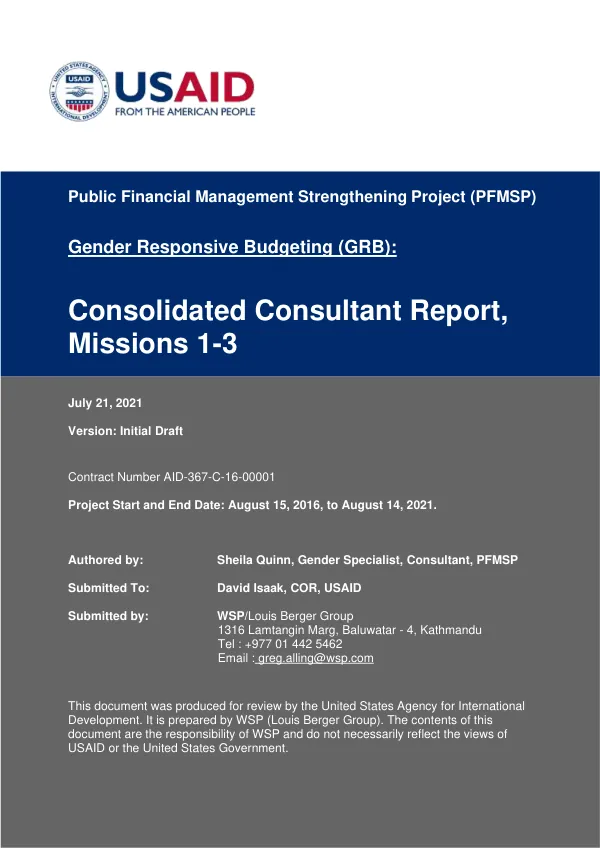
Public Financial Management Strengthening Project (PFMSP) Gender Responsive Budgeting: Consolidated Consultant Report
Sign inTHE LOUIS BERGER GROUP, INC.
Public Financial Management Strengthening Project (PFMSP) Gender Responsive Budgeting: Consolidated Consultant Report
The agricultural development initiative in Nepal began in 2018 with funding from USAID's PFMSP.
2021 · 413 pages
Sign in to readA free account is required to download.
Abstract
The initiative aimed to enhance the capacity of the Government of Nepal (GON) to implement public financial management (PFM) systems. The project's objectives included assisting the GON in its efforts to apply a gender perspective to the budget, assisting development partners and civil society organizations (CSOs) in understanding gender budgeting, and contributing to the capacity development of USAID staff. The GON has been engaging with gender budgeting since the 2000s, with the Ministry of Finance issuing a comprehensive guideline in 2007. The guideline requires all ministries to apply a classification system to gauge the gender responsiveness of their budgetary demands. However, there has been a lack of documentation on how the indicators are used to identify progress markers. The classification approach to gender budgeting in Nepal has been in place since its initiation, with support from UN Women. However, a distinction needs to be made between identifying a budgetary activity's relevance to gender equality and rendering it responsive to the gender needs of the population. The project's evaluation of the system had been requested by the GON, but UN Women had been unable to engage the right evaluators. The PFMSP provided an opportunity to support the GON in deepening its application of a gender perspective to the budget. The project's objectives included reviewing materials contained in Nepal's budget documents and laws related to gender budgeting, assessing the GON's documents and policies relative to internationally accepted best practice, and recommending time-bound actions for closer alignment with best practice. The project's activities included reviewing materials prepared by active stakeholders in Nepal, assessing the GON's documents and policies, and recommending practical examples for closer alignment with best practice. The project's evaluation of the system had been requested by the GON, but UN Women had been unable to engage the right evaluators. The project's objectives included assisting the GON in its efforts to apply a gender perspective to the budget, assisting development partners and CSOs in understanding gender budgeting, and contributing to the capacity development of USAID staff. The project's activities included reviewing materials contained in Nepal's budget documents and laws related to gender budgeting, assessing the GON's documents and policies relative to internationally accepted best practice, and recommending practical examples for closer alignment with best practice. The project's evaluation of the system had been requested by the GON, but UN Women had been unable to engage the right evaluators. The project's objectives included assisting the GON in its efforts to apply a gender perspective to the budget, assisting development partners and CSOs in understanding gender budgeting, and contributing to the capacity development of USAID staff. The project's activities included reviewing materials contained in Nepal's budget documents and laws related to gender budgeting, assessing the GON's documents and policies relative to internationally accepted best practice, and recommending practical examples for closer alignment with best practice. The project's evaluation of the system had been requested by the GON, but UN Women had been unable to engage the right evaluators.