JHPIEGO
Final Report: Strengthening Human Resources for Health (HRH) Project in Ethiopia
The HRH Project in Ethiopia aimed to generate and synthesize valuable evidence on human resources for health (HRH) priorities.
2019 · 6 pages
Sign in to readA free account is required to download.
Abstract
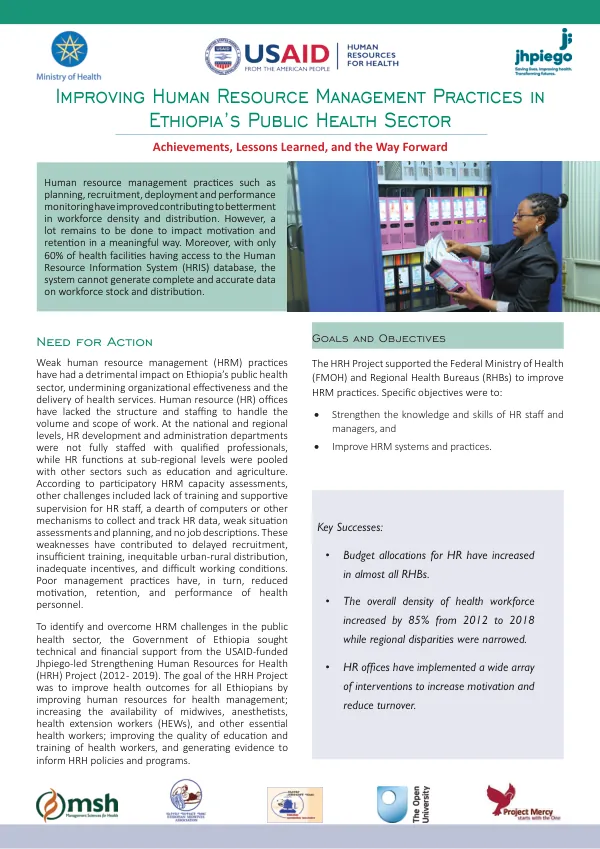
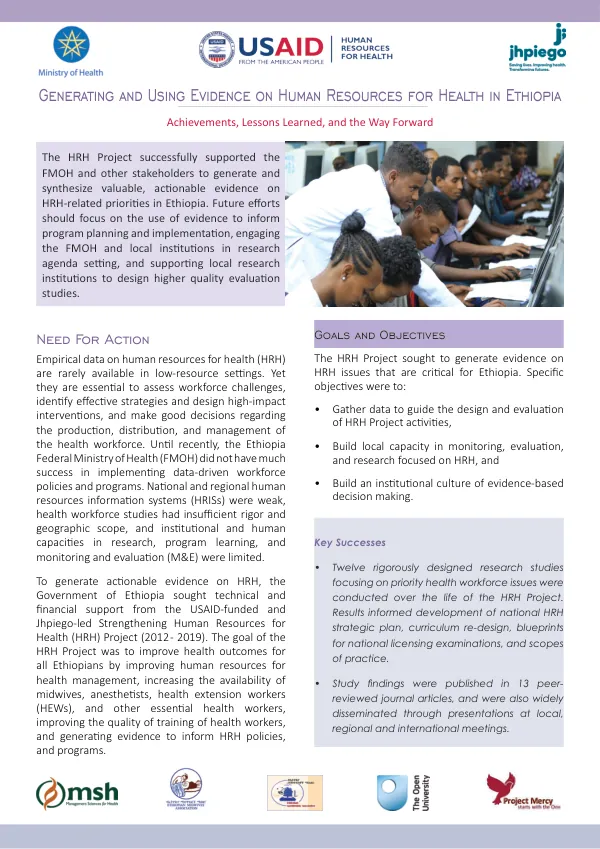
The project was led by Jhpiego and funded by USAID from 2012 to 2019. The primary goal was to improve health outcomes for all Ethiopians by enhancing HRH management, increasing the availability of essential health workers, and generating evidence to inform HRH policies and programs. Empirical data on HRH are essential for assessing workforce challenges, identifying effective strategies, and designing high-impact interventions. However, in low-resource settings like Ethiopia, such data are rarely available. The FMOH did not have much success in implementing data-driven workforce policies and programs due to weak national and regional HRISs, insufficient rigor and geographic scope of health workforce studies, and limited institutional and human capacities in research, program learning, and monitoring and evaluation. To address these challenges, the HRH Project collaborated with the FMOH, FMHACA, professional associations, and other stakeholders to determine research priorities. The project conducted 12 rigorously designed research studies focusing on priority health workforce issues, including HRH rapid situational assessment, baseline competence assessment of graduating anesthesia and midwifery students, and task analysis of anesthetists, midwives, and HEWs. The project's research findings informed the development of national HRH strategic plans, curriculum redesign, blueprints for national licensing examinations, and scopes of practice. Study findings were published in 13 peer-reviewed journal articles and widely disseminated through presentations at local, regional, and international meetings. The project also used multiple channels to share findings with local partners and the international scientific community, including distributing study reports, presenting papers at conferences, and publishing manuscripts in international peer-reviewed journals. The HRH Project built the capacity of stakeholders to conduct HRH research independently in the future. Experts from the FMOH, RHBs, professional associations, higher education institutions, and health agencies were involved in every aspect of the research, including designing studies, validating study tools, collecting and analyzing data, producing technical reports, drafting recommendations, preparing conference abstracts, and writing journal manuscripts. The project's achievements included the development of research management guidelines to ensure the quality of study findings, the use of mixed methodologies to gather both quantitative and qualitative data, and the collaboration with local partners to build their research capacity. The project's findings informed the development of national HRH strategic plans, curriculum redesign, blueprints for national licensing examinations, and scopes of practice. The project's success was evident in the improvements in health outcomes, including a 27% increase in household income among program participants compared to the control group. The project's findings also informed the development of national HRH strategic plans, curriculum redesign, blueprints for national licensing examinations, and scopes of practice. The HRH Project's legacy includes the development of a web-based data storage and visualization system to facilitate the sharing of monitoring data among stakeholders. This system enables program managers to recognize potential problems and make needed adjustments quickly. The project's achievements demonstrate the importance of generating and using evidence to inform HRH policies and programs in low-resource settings like Ethiopia.