USAID DEC
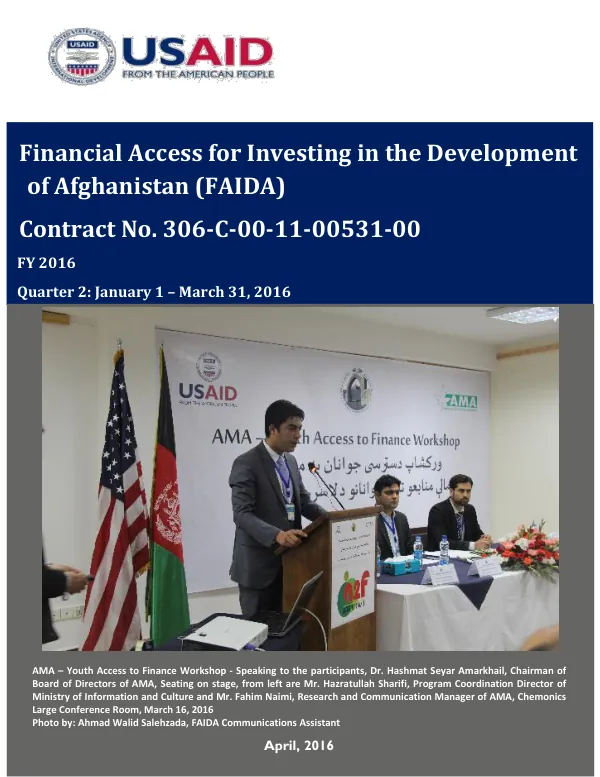
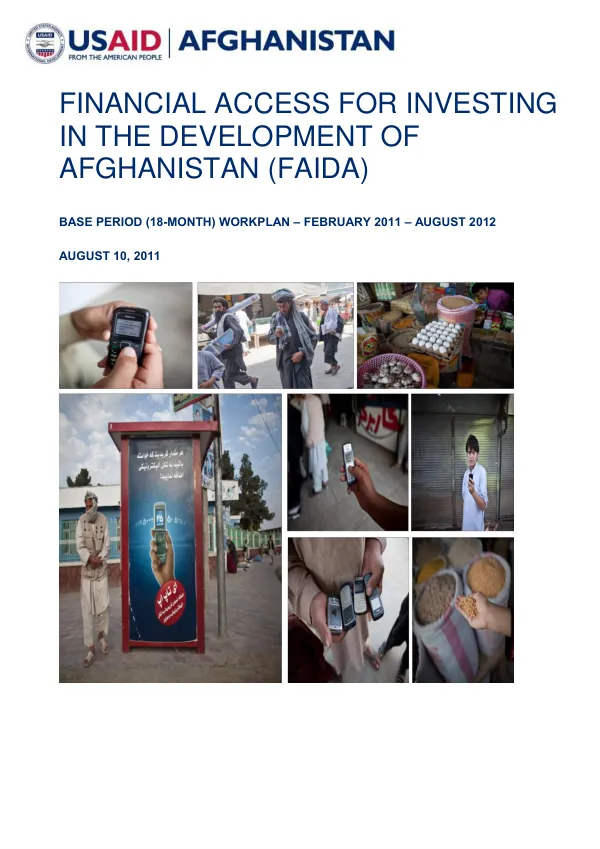
Financial Access for Investing in the Development of Afghanistan (FAIDA) First Option-Period Work Plan
Sign inCHEMONICS
Financial Access for Investing in the Development of Afghanistan (FAIDA) First Option-Period Work Plan
The Financial Access for Investing in the Development of Afghanistan (FAIDA) project was awarded to Chemonics International Inc.
2011 · 39 pages
Sign in to readA free account is required to download.
Abstract
under Contract Number 306-C-11-00531 in February 2011. FAIDA's core mission is to create jobs by developing a sustainable, diverse, and inclusive financial sector that will meet the needs of micro, small, and medium enterprises throughout the country, with a special focus on the agricultural sector and the southern and eastern regions of Afghanistan. FAIDA will be implemented by a team including Chemonics, CNFA, and AZMJ, and an extensive roster of Afghan counterparts and partners, including the Da Afghanistan Bank (DAB), Microfinance Investment Support Facility for Afghanistan (MISFA), Afghanistan Banks Association (ABA), Afghanistan Institute of Banking and Finance (AIBF), Afghanistan Microfinance Association (AMA), Afghanistan Chamber of Commerce and Industry (ACCI), The American University of Afghanistan (AUA), microfinance institutions and commercial banks, and mobile network operators. FAIDA will develop a sustainable, diverse, and inclusive financial sector that meets the needs of micro, small, and medium enterprises throughout the country, particularly in the agricultural sector and the South and East, by using a financial systems approach, working at the micro, meso, and macro levels of Afghanistan's financial services sector. At the micro level, the financial sector will see a dramatic expansion in financial sector outreach through the development of innovative, culturally appropriate, and demand-driven financial products and the expansion of financial services for underserved micro, small, and medium enterprises (MSMEs). At the meso level, FAIDA will drive an aggressive program to enhance the capacity of financial system support institutions and market infrastructure with interventions to build human and organizational capacity, and promote development of innovative systems like mobile money. At the macro level, FAIDA will support development of an improved enabling environment and better regulation through Afghan-led advocacy efforts and promoting policies that support the development of Afghanistan's financial sector. The FAIDA program is designed to transfer management responsibility to Afghan staff. Each of the three Result Leaders for FAIDA's micro, meso, and macro level activities, and each of their operating teams, will have an Afghan Deputy. These Afghan leaders will be identified and selected within the first nine months of the project. These deputies will benefit from extensive capacity building opportunities and are expected to assume progressively greater management responsibilities. FAIDA's Chief of Party Olin McGill has overall responsibility for the project and directly directs and oversees all project activities. Result 2 Team Leader Phil Smith acts as Deputy Chief of Party Emeritus, contributing to the technical results of his own and other result teams. The Result 1 team, led by Rick Pierce, is responsible for micro-level activities to expand the breadth, depth, and reach of Afghanistan's financial sector, particularly in the South and East. The FAIDA project will be implemented over a period of 18 months, from February 2011 to August 2012. The project will be monitored and evaluated through a Performance Management Plan (PMP) that will track progress against key performance indicators (KPIs) and provide regular updates to stakeholders. The project will also establish a Monitoring and Evaluation Unit (MEU) to oversee the monitoring and evaluation process and provide technical assistance to project staff. FAIDA's work plan is divided into four main components: micro-level activities, meso-level activities, macro-level activities, and support activities. Micro-level activities will focus on expanding the breadth, depth, and reach of Afghanistan's financial sector, particularly in the South and East. Meso-level activities will focus on enhancing the capacity of financial system support institutions and market infrastructure. Macro-level activities will focus on supporting development of an improved enabling environment and better regulation. Support activities will include project administration, strategic activities fund, project communications, and monitoring and evaluation. The project will also establish a relationship with Afghan partners, including the Da Afghanistan Bank, Microfinance Investment Support Facility for Afghanistan, and Afghanistan Banks Association, to ensure effective collaboration and coordination. The FAIDA project will have a significant impact on the development of Afghanistan's financial sector, particularly in the agricultural sector and the South and East. The project will create jobs, stimulate economic growth, and improve access to financial services for micro, small, and medium enterprises. The project will also contribute to the development of a more stable and inclusive financial sector that will support the country's economic development and stability.