USAID DEC
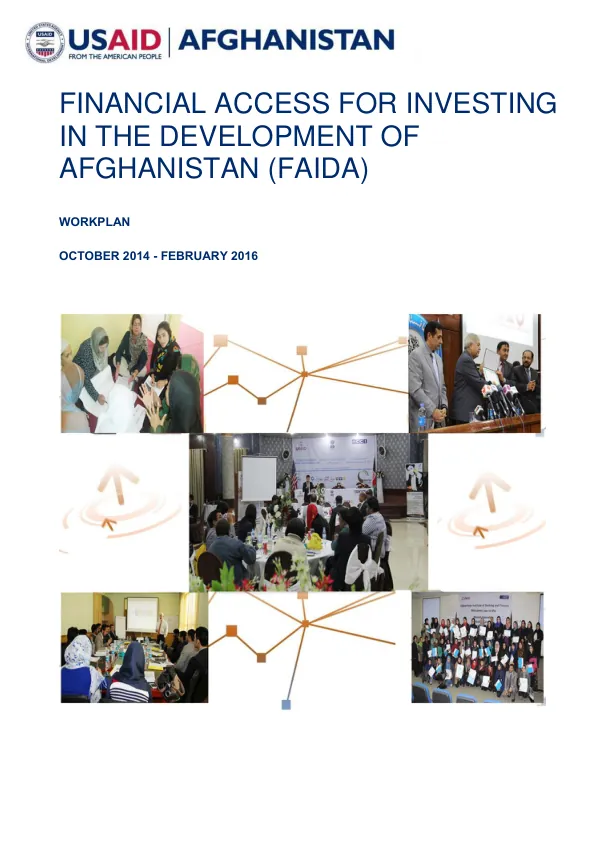
Financial Access for Investing in the Development of Afghanistan (FAIDA) Workplan 2014-2016
Sign inBATANGAS PROVINCE CHAMBER OF COMMERCE AND INDUSTRY, INC.
Financial Access for Investing in the Development of Afghanistan (FAIDA) Workplan 2014-2016
The Financial Access for Investing in the Development of Afghanistan (FAIDA) project, under Contract Number 306-C-00-11-00531-00, assists the Government of the Islamic Republic of Afghanistan and the private sector in developing the financial sector.
2014 · 28 pages
Sign in to readA free account is required to download.
Abstract
FAIDA helps USAID's Afghan partners in building capacity to deliver finance where it can be used most effectively, and in developing a legal framework and market infrastructure in which financial sector institutions and their business partners create value that provides growth and employment opportunities for all Afghans. The project provides technical assistance to Afghanistan's mobile network operators to introduce innovative mobile money products and services. It supports initiatives designed to support a sustainable, commercially viable, agribusiness-based economy as the best way to achieve long-term stability, security, and enduring peace in Southern Afghanistan. FAIDA also directly assists Afghan women entrepreneurs by providing specially targeted business development trainings to enable them to gain access to financing and opportunities for economic and professional growth. The FAIDA project is implemented by a consortium made up of Chemonics, Crimson Capital, and Connexus (formerly AZMJ), and an extensive roster of Afghan counterparts and partners, including the Microfinance Investment Support Facility for Afghanistan (MISFA), Afghanistan Banks Association (ABA), Afghanistan Institute of Banking and Finance (AIBF), Afghanistan Microfinance Association (AMA), microfinance institutions, and commercial banks and mobile network operators. The FAIDA contract was signed in February 2011, with an initial 18-month base period through August 2, 2012. In June 2012, USAID exercised FAIDA's 24-month option period, up to August 2, 2014, with a 2-month no-cost extension up to October 2, 2014, then USAID extended FAIDA's contract up to February 6, 2016. FAIDA has contributed significantly towards the regular progress of the financial sector in Afghanistan during the last 3 years and 6 months. Some of the achievements of FAIDA include facilitating $34.8 million in private sector loans, with $30 million in loan applications in the pipeline. Additionally, 28,058 families have directly benefited from financial assistance provided, and 2,410 employees of the financial sector have received training and support. The project has also provided business development trainings to Afghan women entrepreneurs, enabling them to gain access to financing and opportunities for economic and professional growth. The FAIDA project has five main components: the Enterprises Component, the Banking Capacity Component, the Regulatory Component, the Branchless Banking and Mobile Money Component, and the Gender Mainstreaming Unit. The Enterprises Component works with partner institutions to provide tailored financial solutions where access to capital will complete value chains and increase competitiveness. The Banking Capacity Component enhances the capacity of financial professionals and infrastructure organizations to strengthen Afghanistan's financial sector. The Regulatory Component creates an enabling lending environment that reduces risk and increases certainty. The Branchless Banking and Mobile Money Component provides technical assistance to Afghanistan's mobile network operators to introduce innovative new products and services and expand the use of mobile money. The Gender Mainstreaming Unit ensures that women are integrated in financial sector activities and are provided access to finance and opportunities for economic and professional growth. The FAIDA project has made significant progress in developing the financial sector in Afghanistan, and its achievements are expected to continue in the future. The project's focus on providing financial assistance to families, facilitating private sector loans, and supporting Afghan women entrepreneurs has contributed to the growth and stability of the financial sector in Afghanistan.