CHEMONICS
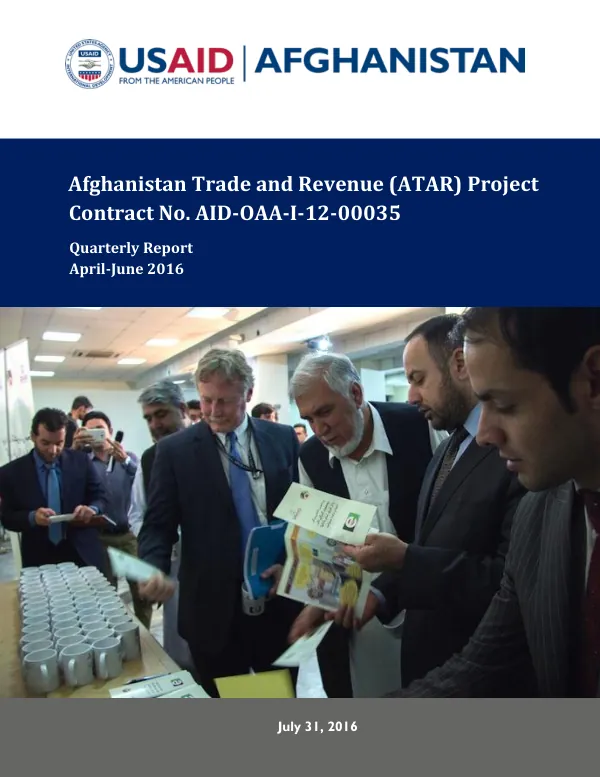
Afghanistan Trade and Revenue (ATAR) Project Quarterly Report for April-June 2016
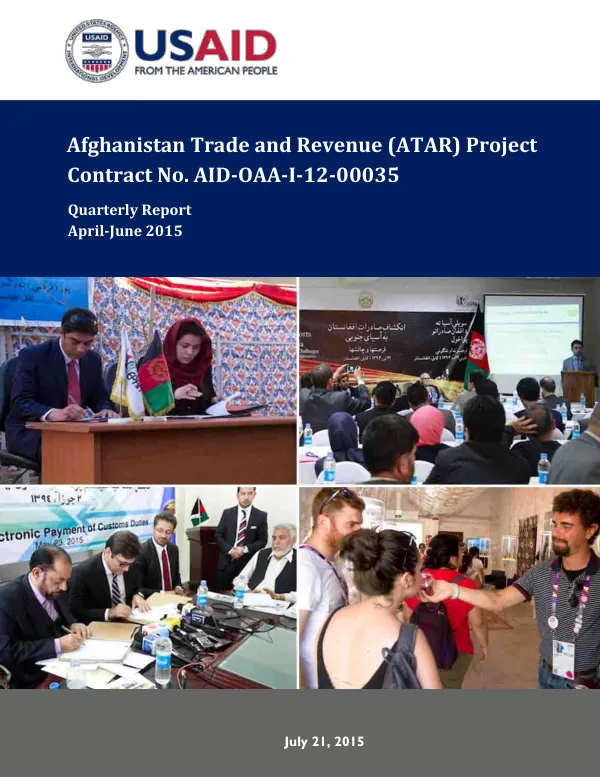
Afghanistan Trade and Revenue (ATAR) Project Quarterly Report for April-June 2016 highlights the project's progress in supporting Afghanistan's integration into the international trading community.
2016 · 57 pages
Sign in to readA free account is required to download.
Abstract
The project, implemented by Chemonics in partnership with the Economic Integration Forum (EIF), aims to help Afghanistan realize its full potential in the global trading market. The project's main objective is to assist the Afghan government in integrating Afghanistan into the World Trade Organization (WTO) and revamping its customs procedures to reap the full benefits of regional and international trade. This improved business climate is expected to pave the way for private investment, enhanced trade, job creation, and fiscal sustainability in the country. Component 1 of the project, Support Trade Policy Liberalization, promotes the liberalization of Afghanistan's trade regime by supporting its accession to the WTO. This is achieved by building capacity and providing technical assistance within implementing institutions to conduct negotiations, draft legislation, and institute reforms required to improve the trade regime in the region and meet WTO requirements. Under Component 2, Facilitate Enhanced Access to Regional Markets, ATAR facilitates the development and implementation of regional trade agreements, assists the government in supporting measures needed to implement regional trade agreements, and supports the implementation of trade agreements with neighboring countries, including Afghanistan-Pakistan Transit Trade Agreement (APTTA) and Afghanistan-Pakistan Transit Trade Coordinating Authority (APTTCA). Component 3, Improved Customs Administration, focuses on strengthening the Afghan Customs Department (ACD) to improve its capacity to administer customs procedures efficiently and effectively. This includes supporting regional integration, organizational compliance, trade compliance, and enhancing the capacity of ACD managers and valuation department. During the reporting period, significant progress was made in implementing the project's activities. The national rollout of E-Pay, an electronic payment system, was announced on June 21 in Kabul, marking a major milestone in the project's efforts to improve customs administration. The system is expected to enhance the efficiency and transparency of customs procedures. The project also made progress in supporting the Afghan government's efforts to integrate into the international trading community. The Afghan government signed a Memorandum of Understanding (MOU) with the World Customs Organization (WCO) to enhance cooperation and capacity building in customs administration. In addition, the project supported the development of a Trade Policy Analysis Unit (TPAU) within the Ministry of Commerce and Industries (MOCI) to provide analytical support to the government in trade policy decision-making. The unit is expected to play a critical role in promoting trade liberalization and facilitating access to regional markets. Overall, the ATAR project has made significant progress in supporting Afghanistan's integration into the international trading community. The project's activities are expected to contribute to the country's economic growth, job creation, and fiscal sustainability.