AVENIR HEALTH
JKN’s Impact on the Private Health Sector in Indonesia
Indonesia's national health insurance scheme, Jaminan Kesehatan Nasional (JKN), has been instrumental in promoting health and well-being among the country's citizens.
2018 · 2 pages
Sign in to readA free account is required to download.
Abstract
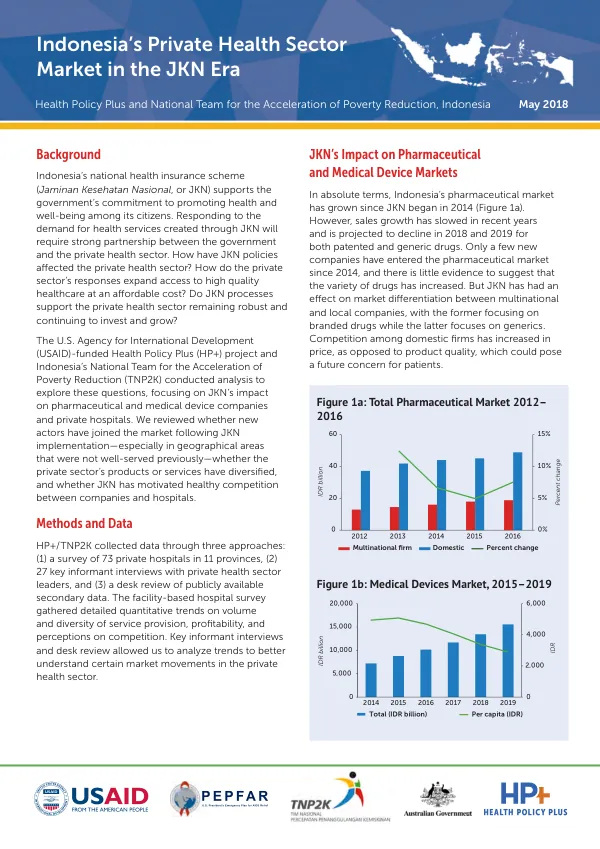
To address the demand for health services created through JKN, a strong partnership between the government and the private health sector is essential. The U.S. Agency for International Development (USAID)-funded Health Policy Plus (HP+) project and Indonesia's National Team for the Acceleration of Poverty Reduction (TNP2K) conducted an analysis to explore the impact of JKN policies on the private health sector. The analysis focused on JKN's impact on pharmaceutical and medical device companies and private hospitals. The researchers collected data through three approaches: a survey of 73 private hospitals in 11 provinces, 27 key informant interviews with private health sector leaders, and a desk review of publicly available secondary data. The facility-based hospital survey gathered detailed quantitative trends on volume and diversity of service provision, profitability, and perceptions on competition. Indonesia's pharmaceutical market has grown since JKN began in 2014, with sales growth slowing in recent years and projected to decline in 2018 and 2019 for both patented and generic drugs. However, JKN has had an effect on market differentiation between multinational and local companies, with the former focusing on branded drugs while the latter focuses on generics. Competition among domestic firms has increased in price, as opposed to product quality, which could pose a future concern for patients. The medical device market in Indonesia, valued at IDR 10.2 trillion in 2016, is projected to continue growing. Before JKN, the market had a low base, but it grew by 12 percent in 2016 and by more than 16 percent in 2017 and 2018 (projected). Growth may reach 18 percent in 2019. The number of medical device companies has not changed, but competition and growth into new geographic areas are increasing. The diversity of products offered has increased in some areas, specifically for diagnostic machines and consumable devices. The number of private hospitals in Indonesia has grown since JKN implementation, with a concentration in Java and Sumatra. For-profit hospital networks' investment since 2014 indicates a desire to benefit from the JKN market. Once the Java and Sumatra urban and peri-urban markets are saturated, expansion into rural areas is likely, where a lack of trained doctors and nurses remains a concern and certain policies around facility construction and licensure may act as barriers. Mixed evidence shows that the INA-CBGs are sufficient to incentivize private hospitals to offer more and additional services, especially those essential for public health, at higher quality. Hospitals with sufficient cash flow are expanding into higher complexity services with a higher net revenue. However, for most hospitals, types of service offered have not expanded significantly, and profit is maximized by reducing costs and offering routine care. Regardless of profit-seeking status, private providers are price-takers on the INA-CBG tariff rates. Our assessment suggests that JKN has grown the private market, incentivized investment, and increased competition, but has yet to holistically motivate greater geographic and/or product diversity. To have a greater positive impact on the private sector, stakeholders should clarify INA-CBG tariff rate setting processes, including costs accounted for in rate calculation, so that private sector players can make informed decisions regarding treatment options. Further use of health technology assessments (HTA) that focus beyond expensive top-up drugs to help inform procedure, drug, and medical device selection processes is also recommended.