AVENIR HEALTH
Financing Family Planning: Costa Rica
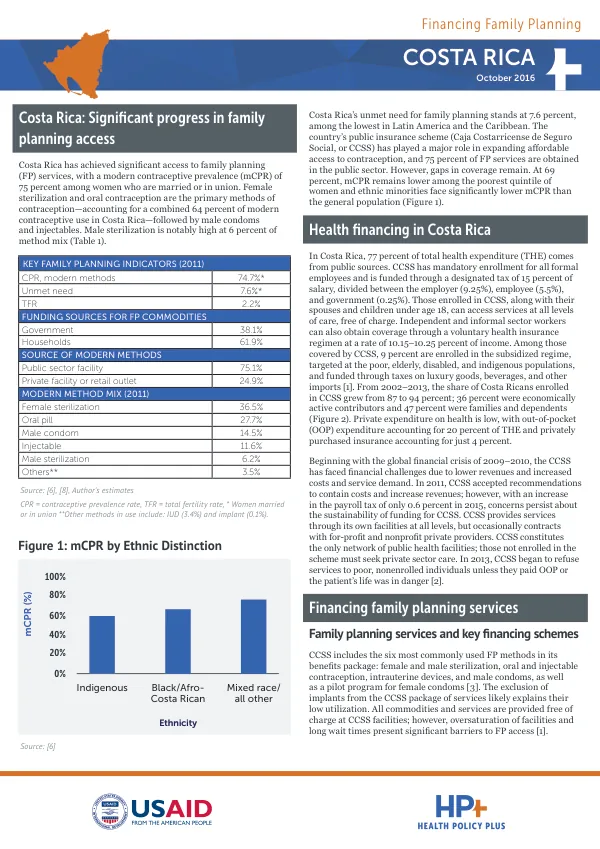
Costa Rica has achieved significant access to family planning services, with a modern contraceptive prevalence rate of 75 percent among women who are married or in union.
2016 · 2 pages
Sign in to readA free account is required to download.
Abstract
Female sterilization and oral contraception are the primary methods of contraception, accounting for a combined 64 percent of modern contraceptive use in Costa Rica. The country's unmet need for family planning stands at 7.6 percent, among the lowest in Latin America and the Caribbean. The public insurance scheme, Caja Costarricense de Seguro Social (CCSS), has played a major role in expanding affordable access to contraception. CCSS has mandatory enrollment for all formal employees and is funded through a designated tax of 15 percent of salary, divided between the employer, employee, and government. Those enrolled in CCSS, along with their spouses and children under age 18, can access services at all levels of care, free of charge. Independent and informal sector workers can also obtain coverage through a voluntary health insurance regimen at a rate of 10.15-10.25 percent of income. Private expenditure on health is low in Costa Rica, with out-of-pocket expenditure accounting for 20 percent of total health expenditure and privately purchased insurance accounting for just 4 percent. The CCSS has faced financial challenges due to lower revenues and increased costs and service demand, beginning with the global financial crisis of 2009-2010. In 2011, CCSS accepted recommendations to contain costs and increase revenues, but concerns persist about the sustainability of funding for CCSS. Costa Rica's family planning services and key financing schemes are provided through CCSS, which includes the six most commonly used FP methods in its benefits package. The exclusion of implants from the CCSS package of services likely explains their low utilization. All commodities and services are provided free of charge at CCSS facilities, but oversaturation of facilities and long wait times present significant barriers to FP access. The country's achievement of near-universal health coverage has been widely touted as a Latin American success story, but barriers to accessing FP services remain. Indigenous and poor women are particularly vulnerable and efforts to expand current CCSS coverage to include them are necessary to achieve universal coverage. Although unmet need for family planning in Costa Rica is among the lowest in the region, it remains high (12%) among the poorest women. Active enrollment of poor, eligible individuals and continued implementation of proposals to contain costs and increase resources for CCSS will be critical to ensure that FP services are truly accessible to all Costa Ricans.