AVENIR HEALTH
HEP+ Guatemala: Focus on Youth
The Health and Education Policy Plus (HEP+) program in Guatemala aims to strengthen in-country partners' capacity to navigate complex environments for effective policy design, implementation, and financing aligned to their priorities.
2021 · 2 pages
Sign in to readA free account is required to download.
Abstract
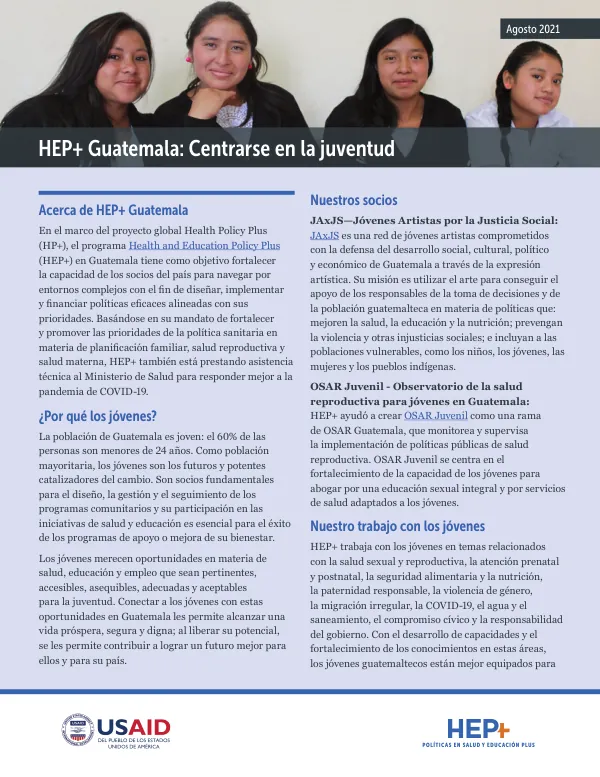
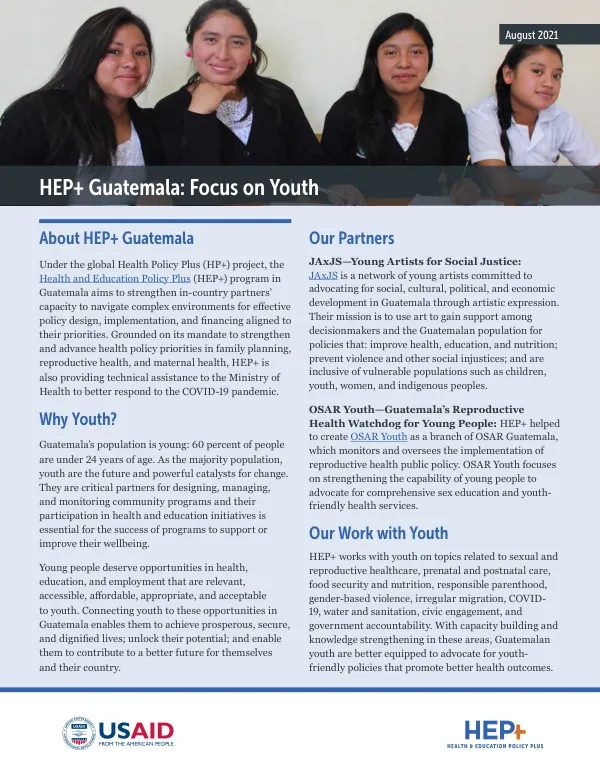
Grounded on its mandate to strengthen and advance health policy priorities in family planning, reproductive health, and maternal health, HEP+ is also providing technical assistance to the Ministry of Health to better respond to the COVID-19 pandemic. Guatemala's population is young, with 60 percent of people under 24 years of age. As the majority population, youth are the future and powerful catalysts for change. They are critical partners for designing, managing, and monitoring community programs and their participation in health and education initiatives is essential for the success of programs to support or improve their wellbeing. Young people deserve opportunities in health, education, and employment that are relevant, accessible, affordable, appropriate, and acceptable to youth. HEP+ works with youth on topics related to sexual and reproductive healthcare, prenatal and postnatal care, food security and nutrition, responsible parenthood, gender-based violence, irregular migration, COVID-19, water and sanitation, civic engagement, and government accountability. With capacity building and knowledge strengthening in these areas, Guatemalan youth are better equipped to advocate for youth-friendly policies that promote better health outcomes. The program focuses on strengthening the capability of young people to advocate for comprehensive sex education and youth-friendly health services. HEP+ has established partnerships with youth organizations, including JAxJS—Young Artists for Social Justice and OSAR Youth—Guatemala's Reproductive Health Watchdog for Young People. JAxJS is a network of young artists committed to advocating for social, cultural, political, and economic development in Guatemala through artistic expression. OSAR Youth focuses on monitoring and overseeing the implementation of reproductive health public policy. Through these partnerships, HEP+ has facilitated commitments between youth groups and local mayors, legislators, and government agency representatives to foster trust and promote youth needs. The program has achieved significant impact, including brokering over 75 alliances among youth groups and policy stakeholders, adding US$25,000 in new funding for JAxJS for community engagement and monitoring. More than 50 trainings have been held for JAxJS, increasing participant understanding of topics like migration, health, reproductive health, advocacy, social media, public relations, program management, and government accountability by an average of 60 percent. Additionally, 28 mayoral commitments have been made addressing issues advocated by JAxJS, leading to youth-oriented policy wins on youth commissions, educational and vocational trainings, and investments in water and sanitation.