AVENIR HEALTH
HEP+ Guatemala: Data to Strengthen Governance
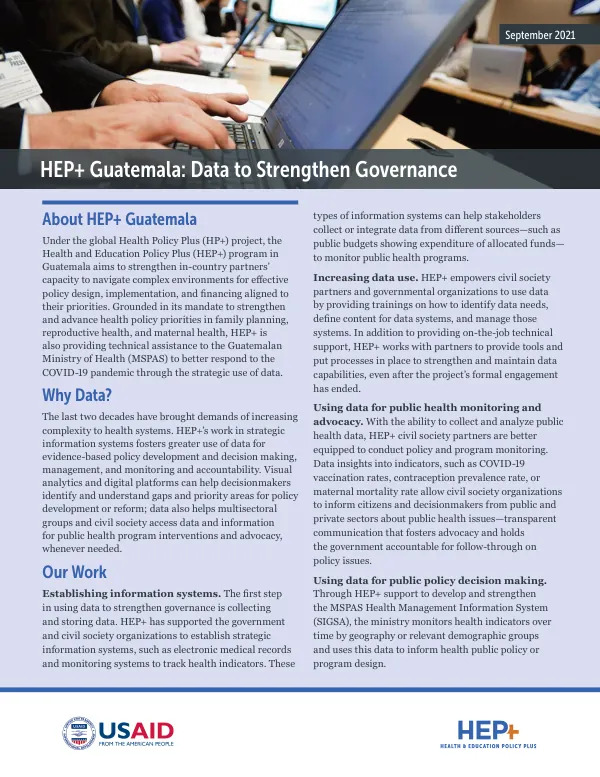
The Health and Education Policy Plus (HEP+) program in Guatemala aims to strengthen in-country partners' capacity to navigate complex environments for effective policy design, implementation, and financing aligned to their priorities.
2021 · 2 pages
Sign in to readA free account is required to download.
Abstract
Grounded in its mandate to strengthen and advance health policy priorities in family planning, reproductive health, and maternal health, HEP+ is also providing technical assistance to the Guatemalan Ministry of Health (MSPAS) to better respond to the COVID-19 pandemic through the strategic use of data. HEP+ fosters greater use of data for evidence-based policy development and decision making, management, and monitoring and accountability. Strategic information systems, such as electronic medical records and monitoring systems to track health indicators, can help stakeholders collect or integrate data from different sources to monitor public health programs. HEP+ empowers civil society partners and governmental organizations to use data by providing trainings on how to identify data needs, define content for data systems, and manage those systems. The HEP+ program has established a mobile application for OSAR, the Sexual and Reproductive Health Watchdog, which aggregates publicly available data from multiple sources regarding indicators on local contraception, maternal and infant mortality, and adolescent pregnancy. OSAR analyzes the data as a part of their monitoring and advocacy exercises, using the findings to inform citizens and decisionmakers about public health issues and hold the government accountable for follow-through on policy issues. HEP+ has also supported the establishment of the Decentralization Process System (SIPRODES), a strategic information system that assesses the readiness of municipalities to be entrusted with delegated functions from central government agencies. Additionally, the COVID-19 vaccination dashboard provides MSPAS with biweekly vaccination rates per department, allowing decisionmakers to monitor the implementation of the National Vaccination Plan and determine vaccine allocation and delivery. The HEP+ program has also developed several other tools and systems to support data-driven decision making, including the 1,000-Day Window information tool, the Integral Healthcare Directorate (SIAS) Territoriality Prioritization Tool, and the National Contraceptive Security Commission (CNAA) Indicator Monitoring System. These tools provide data on indicators related to infant and child health, health services gaps, and contraceptive security, allowing civil society and government institutions to make informed decisions and hold each other accountable for improving health outcomes.