USAID DEC
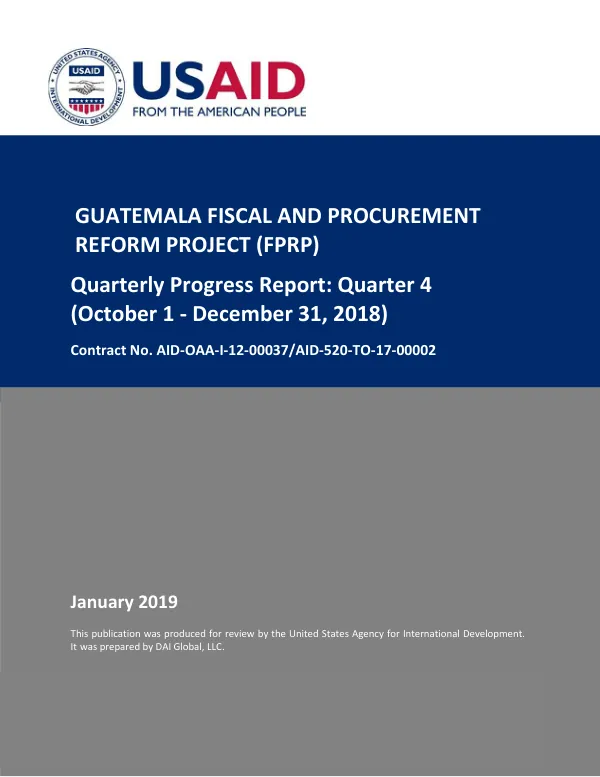
Fiscal and Procurement Reform Project (FPRP) Annual Progress Report (October 1, 2018 - December 31, 2018)
Sign inCHEMONICS
Fiscal and Procurement Reform Project (FPRP) Annual Progress Report (October 1, 2018 - December 31, 2018)
The Fiscal and Procurement Reform Project (FPRP) in Guatemala aimed to strengthen the country's fiscal and procurement systems.
2019 · 84 pages
Sign in to readA free account is required to download.
Abstract
The project, funded by the United States Agency for International Development (USAID), was implemented by DAI Global, LLC. The project's primary objective was to enhance the efficiency and transparency of Guatemala's public financial management and procurement processes. The project focused on two main components: Domestic Resource Mobilization and Expenditure Management and Procurement Reform. Domestic Resource Mobilization aimed to improve the country's tax administration and revenue collection, while Expenditure Management and Procurement Reform sought to enhance the efficiency and transparency of public procurement processes. Under the Domestic Resource Mobilization component, several activities were implemented, including the business process reengineering of the Superintendency of Taxes (SAT) and the improvement of the accuracy and reliability of the Taxpayer Registry (RTU). Additionally, the project supported the definition of a Tax Compliance Risk Framework and the pilot implementation of risk-based actions. The project also conducted a citizen perception and cost of compliance survey, as well as gender focus groups, to better understand the impact of tax policies on citizens. The Expenditure Management and Procurement Reform component focused on transforming Guatemala's public procurement system into a more efficient and transparent process. This involved the reform of the public procurement law, the transformation of GUATECOMPRAS into a transactional e-procurement system, and the creation of the General Registry of Government Procurement. The project also conducted human and institutional strengthening of the General Directorate for Public Procurement (DGAE). The project made significant progress during the reporting period, with several key milestones and deliverables achieved. These included the completion of the business process reengineering of SAT, the improvement of the accuracy and reliability of the RTU, and the transformation of GUATECOMPRAS into a transactional e-procurement system. The project also conducted several technical reports and deliveredables, including the citizen perception and cost of compliance survey and the gender focus groups. The project's performance was monitored and evaluated through the use of performance indicators, which tracked progress against project objectives. The project's budget expenditures were also closely monitored, with a focus on ensuring that funds were being used efficiently and effectively. The project's next quarter plan included several key activities, including the provision of short-term technical assistance, coordination and collaboration with stakeholders, and the reporting of project progress. The project also faced several challenges during the reporting period, including the need to address issues related to the implementation of the tax compliance risk framework and the transformation of GUATECOMPRAS into a transactional e-procurement system. Overall, the Fiscal and Procurement Reform Project in Guatemala made significant progress during the reporting period, with several key milestones and deliverables achieved. The project's focus on improving the efficiency and transparency of Guatemala's public financial management and procurement processes is critical to the country's economic development and growth.
Related documents