USAID
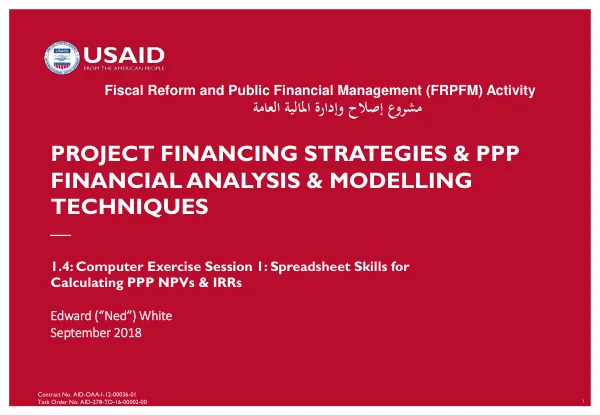
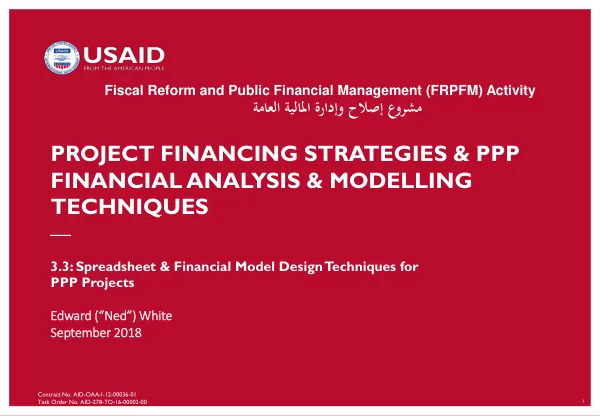
Fiscal Reform and Public Financial Management (FRPFM) Activity
The Fiscal Reform and Public Financial Management (FRPFM) Activity is a project aimed at improving public financial management in a specific region.
2018 · 32 pages
Sign in to readA free account is required to download.
Abstract
The project is funded by the United States Agency for International Development (USAID) and is implemented through a contract with a private partner. The project's financial analysis and modeling techniques are critical components of its success. One of the key aspects of the project is the design of financial spreadsheet models for public-private partnerships (PPPs) and project financings. These models are used to select key outputs for various stakeholders, including governments, end-users, investors, lenders, and labor. Effective PPP financial models must be based on the needs of relevant stakeholders, be robust, clear, and easy to understand, flexible, and easy to audit and double-check. The models should be able to deliver clear, definitive, and meaningful results to stakeholders that they can take actions on. They should also be able to readily handle changes to key inputs and assumptions about the project's structure. The steps in PPP financial modeling involve clearly understanding the purpose and goal of the new project, identifying the benefits the project is trying to deliver, and determining how these benefits can be measured by the model. The model should also identify the key stakeholders and what each stakeholder wants from the project. Designing financial models for PPPs involves considering the needs of various stakeholders, including consumers, governments, lenders, investors, and others. The models should include key inputs and results, demand for service, capital investment, profit and loss statement, cash flow, balance sheet, and financing structure. The PPP project cycle phases involve project concept and identification, feasibility analysis and PPP risk structuring, PPP bid evaluation, and lender due diligence and financial structuring. The financial models should be used to support project decision-making and risk assessment. The quality of PPP project data and input assumptions is critical to the success of the project. The data gathering process should be clearly managed, and sources for all key input assumptions should be identified, updated, and re-verified during the review and testing of the financial model. The models should be able to deliver results that are as good as the accuracy of their key input assumptions. The project's financial models should be designed to be robust, flexible, and easy to understand. They should be able to handle changes to key inputs and assumptions about the project's structure and deliver clear, definitive, and meaningful results to stakeholders. The models should also be able to support project decision-making and risk assessment. The project's financial models should include key inputs and results, demand for service, capital investment, profit and loss statement, cash flow, balance sheet, and financing structure. The models should be used to support project decision-making and risk assessment, and they should be able to deliver results that are as good as the accuracy of their key input assumptions. The project's financial models should be designed to be user-friendly and easy to understand. They should be able to deliver clear, definitive, and meaningful results to stakeholders that they can take actions on. The models should also be able to readily handle changes to key inputs and assumptions about the project's structure and deliver results that are as good as the accuracy of their key input assumptions. The project's financial models should be used to support project decision-making and risk assessment. They should be able to deliver results that are as good as the accuracy of their key input assumptions and be used to identify the benefits the project is trying to deliver and determine how these benefits can be measured by the model. The models should also be able to handle changes to key inputs and assumptions about the project's structure and deliver clear, definitive, and meaningful results to stakeholders.