USAID DEC
Technical Knowledge Brief: Reducing Gender Barriers and Advancing Policies to Expand Women's Opportunities in the Workforce
Sign inBANYAN GLOBAL
Technical Knowledge Brief: Reducing Gender Barriers and Advancing Policies to Expand Women's Opportunities in the Workforce
Reducing Gender Barriers and Advancing Policies to Expand Women's Opportunities in the Workforce is a critical area of focus for organizations seeking to promote gender equality and empower women in the workforce.
2021 · 4 pages
Sign in to readA free account is required to download.
Abstract
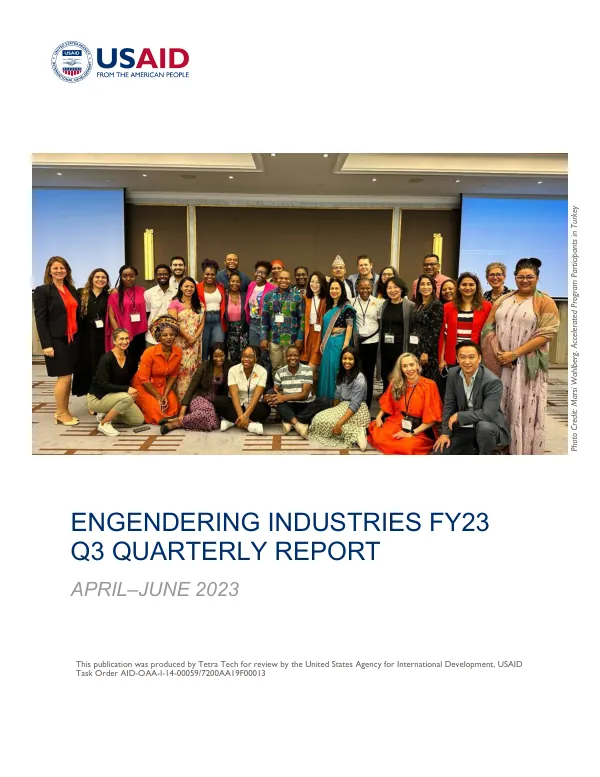
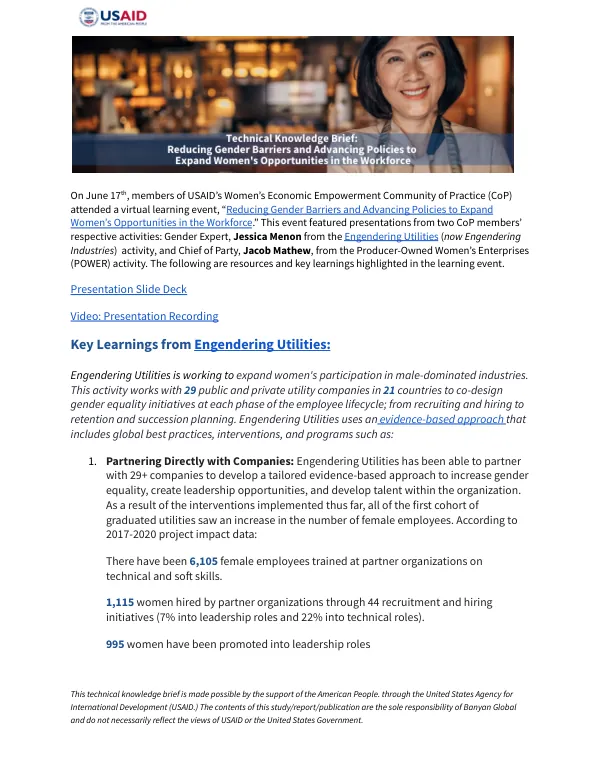
On June 17th, members of USAID's Women's Economic Empowerment Community of Practice (CoP) attended a virtual learning event, "Reducing Gender Barriers and Advancing Policies to Expand Women's Opportunities in the Workforce." This event featured presentations from two CoP members' respective activities: Gender Expert, Jessica Menon from the Engendering Utilities (now Engendering Industries) activity, and Chief of Party, Jacob Mathew, from the Producer-Owned Women's Enterprises (POWER) activity. Engendering Utilities is working to expand women's participation in male-dominated industries by partnering with 29 public and private utility companies in 21 countries to co-design gender equality initiatives at each phase of the employee lifecycle. This includes recruiting and hiring, retention, and succession planning. Engendering Utilities uses an evidence-based approach that includes global best practices, interventions, and programs such as partnering directly with companies, the Gender Equity Executive Leadership Course, and the Workforce Gender Equality Accelerated Program. As a result of these interventions, all of the first cohort of graduated utilities saw an increase in the number of female employees. According to 2017-2020 project impact data, 6,105 female employees were trained on technical and soft skills, 1,115 women were hired through 44 recruitment and hiring initiatives, and 995 women were promoted into leadership roles. The Delivering Gender Equality: A Best Practices Framework for Male-Dominated Industries compiles global best practices to increase gender equity throughout the employee life cycle. The Framework is divided into twelve categories, eight of which are phases of an employee life cycle, and four that represent organizational enablers to gender equity. Engendering Utilities identified the employee life cycle as a key entry point to effecting long-lasting and impactful change within partner electricity and water utilities. The Gender Equity Executive Leadership Course, developed by USAID and Georgetown University McDonough School of Business, empowers key decision-makers to effectively integrate gender equality initiatives across their corporate structure. As a result of the Course, the ten graduating utilities have implemented more than 190 gender equality activities, trained 3,700 women on technical and soft skills to support career advancement, and trained 730 men and 800 women on gender equality issues. Producer-Owned Women's Enterprises (POWER) builds women-owned enterprises and connects them to national and international supply chains, aiming to address restrictive social norms to increase support for women entrepreneurs. This activity aims to impact 6,800 women over three years, working across three value chains: natural banana bark fabrics, bamboo, and non-timber forest products (NTFPs) biodegradable leaf plates. POWER is creating economic opportunities and social empowerment for rural women through social norms change and gender sensitization training. The POWER activity increased women's economic empowerment by facilitating social norms change in rural communities, and 6,800 women producers have participated in the training. A key outcome of the training is a strong support network for these women to rely on and to continue amplifying gender sensitization throughout their communities. Additional resources and tools are available to support organizations in promoting gender equality and empowering women in the workforce. These include the POWER Gender and Capacity Building Training Program Modules, the Delivering Gender Equality: A Best Practices Framework for Male-Dominated Industries, Change Management Coaching for Gender Equality, Developing a Business Case for Gender Equality, Policy Guide: Integrating Gender Equality into Workplace Policies, Guide: Organizational Goal Setting for Gender Equality and Social Inclusion, Guide: Setting Strategic Gender Equality Targets, Case Study: Paternity Leave Beneficial for Business at Indian Utility, and Case Study: Female Perspectives Raise Revenue for Indian Power Utility.