BANGLADESH AGRICULTURAL UNIVERSITY
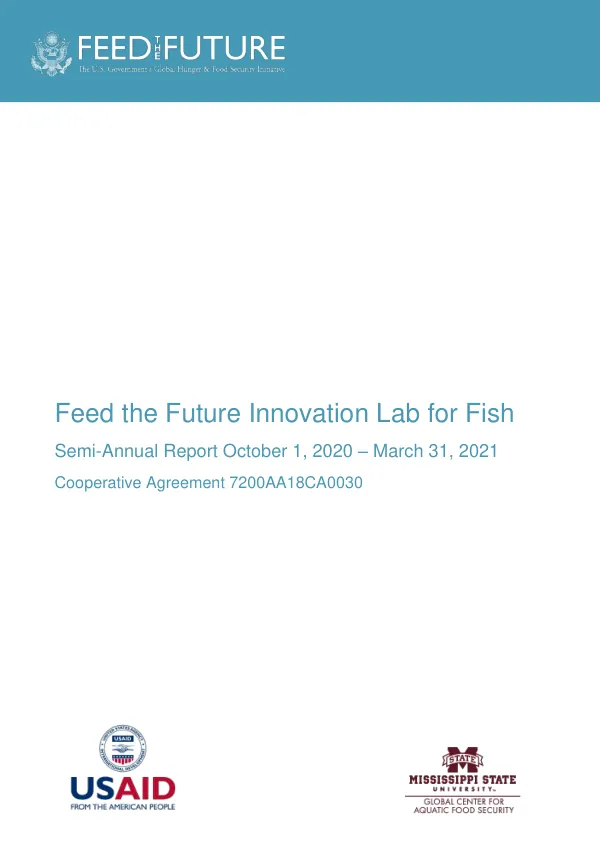
Fish Innovation Lab Year 3 Semiannual Report
The Feed the Future Innovation Lab for Fish is a cooperative agreement between the United States Agency for International Development (USAID) and Mississippi State University's Global Center for Aquatic Food Security.
2021 · 27 pages
Sign in to readA free account is required to download.
Abstract
The lab's semi-annual report for October 1, 2020, to March 31, 2021, highlights progress made in improving aquaculture and fisheries productivity, reducing and mitigating risks to aquaculture and fisheries, and improving human outcomes from the aquaculture and fisheries sector. Objective 1: Improve Aquaculture and Fisheries Productivity The lab's activities focused on improving aquaculture and fisheries productivity through various interventions. Activity 1.1, Aquaculture and Rural Communities, established six adaptive research plots in Nigeria, which are near 90% completion and ready for stocking with fish and rice planting. The team also produced ten wetland maps of the study areas, collected data on situational analyses of nutrition status, gender, and youth involvement, and developed socioeconomic questionnaires. Activity 1.2, No Longer Bugged by Feed Costs, aimed to develop sustainable and scalable aquaculture feedstock to improve catfish producers' and consumers' livelihoods in Nigeria. The University of Ibadan team communicated with local contacts to understand the relevant population and develop survey sampling methods. A pilot fish-farmer survey was developed, and the survey/questionnaire is being programmed into KoBo Toolbox for electronically administered surveys. Activity 1.3, Improving Efficiency in the Nigerian Aquaculture Sector, employed lean production systems to improve efficiency. Planning and preparation for the lean subject-matter experts and lean production-system experts were completed. The participant list, training venue, and provisional agenda for the training were prepared. Two webinars were conducted for the core group of the Lean Production team, and four webinars were conducted for groups of farmers/processors in Ogun State and Delta State. Activity 1.4, Development of Bighead Catfish Culture, aimed to develop sustainable aquaculture in Cambodia. The team worked closely with key partners to provide two virtual trainings to Royal University of Agriculture faculty and students and the Cambodian activity team. The trainings built capacity in the local institution and focused on formulating and preparing aquaculture feeds and managing an aquatic research facility. Activity 1.5, Achieving Coral Reef Fishery Sustainability, aimed to achieve coral reef fishery sustainability in the Kenyan Biodiversity and Climate Refugia Center. The activity was officially launched through small group meetings that reached 217 individuals across the activity sites. Socioeconomic, literacy testing, and fisheries survey tools were developed, translated into the Swahili language, piloted, and administered. Activity 1.6, Cryogenic Sperm Banking, aimed to develop cryogenic sperm banking of Indian major carps and exotic carps for commercial seed production and brood banking. Three MS and two PhD students were recruited, and an activity inception workshop was conducted with 100 key stakeholder participants. The team prepared a memorandum of understanding (MOU) between Bangladesh Agricultural University and the Department of Fisheries for using the government hatchery and nursery facilities. Activity 1.7, Increasing Sustainability of Fisheries, aimed to increase sustainability of fisheries for resilience of Cambodian communities. The team successfully recruited two graduate students in Cambodia and established collaboration with two Cambodian professors from the Royal University of Agriculture. The training of activity personnel in Cambodia is complete, as well as recruitment and training of 15 fishers from villages along the Sre Ambel River. Objective 2: Reduce and Mitigate Risks to Aquaculture and Fisheries The lab's activities focused on reducing and mitigating risks to aquaculture and fisheries through various interventions. Activity 2.1, Improving Biosecurity, aimed to improve biosecurity through a science-based approach to manage fish disease risks and increase the socioeconomic contribution of the Nigerian catfish and tilapia industries. Five online meetings were organized between teams and partners to discuss progress on activity milestones and planning. Enumerators and master's students were appointed at the University of Ibadan (UI). A WorldFish fish epidemiology and health economics survey-based tool was contextualized to Nigeria. Activity 2.2, Identifying Major Sources of Fecal Pathogens, aimed to identify the major sources of fecal pathogens in Bangladeshi aquaculture value chains and evaluate the effectiveness of various risk reduction strategies. Fish collection from retail markets and lab testing activities were launched. Sampling from 11 retail markets and 12 super shops in Dhaka City was completed. A total of 134 samples were collected from retail markets and 47 from super shops. Fish samples were taken to the lab and tested for the presence of different foodborne pathogens. Objective 3: Improve Human Outcomes from the Aquaculture and Fisheries Sector The lab's activities focused on improving human outcomes from the aquaculture and fisheries sector through various interventions. Activity 3.1, Harnessing Machine Learning, aimed to estimate aquaculture production and value chain performance in Bangladesh