PACT
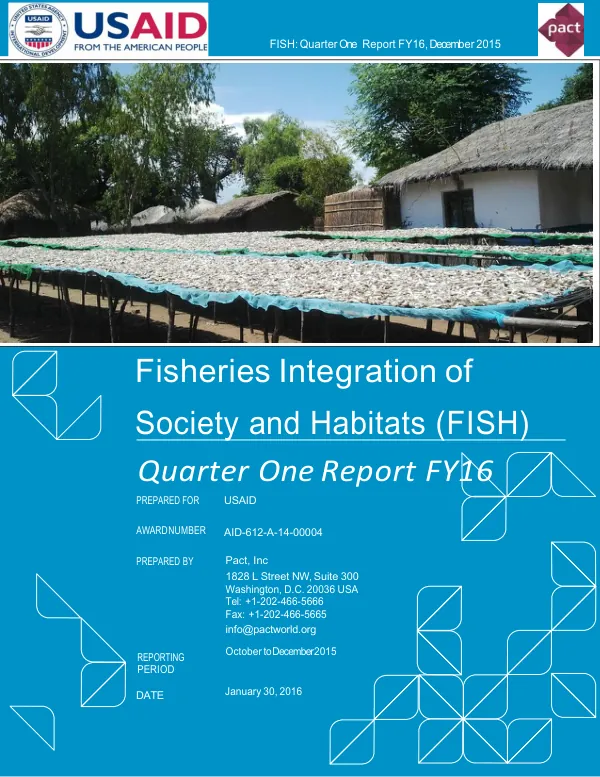
Fisheries Integration of Society and Habitats (FISH) Quarter One Report FY16
The Fisheries Integration of Society and Habitats (FISH) project in Malawi began on September 9, 2014, and will conclude on September 9, 2019.
2016 · 62 pages
Sign in to readA free account is required to download.
Abstract
The project is funded by the United States Agency for International Development (USAID) through a cooperative agreement with Pact, Inc. The overall objective of the project is to improve the management and conservation of freshwater ecosystems in Malawi, with a focus on sustainable fisheries management and biodiversity conservation. The project has four main outputs: increased utilization of science, analysis, and information for decision-making; an enabling environment for conservation and management of freshwater ecosystems; reduced priority threats to freshwater ecosystem biodiversity; and increased adoption of climate change adaptation measures that support resilience of communities and freshwater ecosystems. The project is implemented in Malawi, with a focus on the Lake Malawi basin. The project has made significant progress in the first quarter of FY16, with several key achievements reported. Under Output A1, the project has increased access to science, analysis, and information, with the establishment of a knowledge management system and the development of a climate change adaptation plan. The project has also deepened understanding of threats to biodiversity and climate change, and options for conservation within freshwater ecosystems. Under Output B2, the project has enhanced the enabling environment for conservation and management of freshwater ecosystems, with improvements to the legal framework for sustainable fisheries management and biodiversity conservation. The project has also advanced transparency, representation, and accountability in decision-making, with the establishment of a project advisory committee and the development of a participatory vulnerability and capacity assessment. The project has also made progress under Output C3, with the evaluation and promotion of improved natural resource management practices and sustainable fishing practices. Under Output D4, the project has identified, evaluated, and promoted ecosystem-based adaptation solutions and alternative, scalable, and sustainable climate-resilient livelihood options. The project has faced several challenges in the first quarter of FY16, including delays in the implementation of some activities and difficulties in engaging with some stakeholders. However, the project has taken several actions to address these challenges, including the development of a project management plan and the establishment of a project management unit. The project has also identified several lessons learned and best practices, including the importance of engaging with local communities and stakeholders in the planning and implementation of project activities. The project has also recommended several actions for the next quarter, including the completion of a midterm evaluation and the development of a project management plan. The project has several partners, including the Government of Malawi, the University of Malawi, and several non-governmental organizations. The project has also established several working relationships with other organizations, including the Food and Agriculture Organization of the United Nations and the Global Environment Facility. The project has several references, including the USAID Country Development Cooperation Strategy for Malawi and the Malawi Spatial Data Platform. The project has also developed several performance indicator reference sheets and a performance monitoring and evaluation plan. Overall, the FISH project in Malawi has made significant progress in the first quarter of FY16, with several key achievements reported. The project has faced several challenges, but has taken several actions to address these challenges. The project has identified several lessons learned and best practices, and has recommended several actions for the next quarter.