USAID DEC
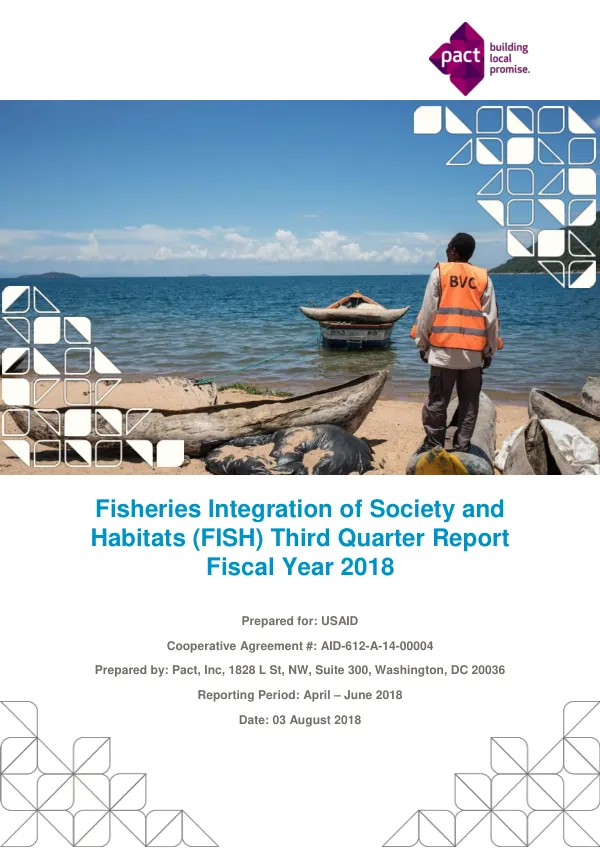
Fisheries Integration of Society and Habitats (FISH) Third Quarter Report Fiscal Year 2018
Sign inPACT
Fisheries Integration of Society and Habitats (FISH) Third Quarter Report Fiscal Year 2018
The FISHERIES INTEGRATION OF SOCIETY AND HABITATS (FISH) project is a five-year initiative aimed at promoting sustainable fisheries management and conservation of freshwater ecosystems in Malawi.
2018 · 58 pages
Sign in to readA free account is required to download.
Abstract
The project is funded by USAID and implemented by Pact, Inc. in partnership with local organizations. The project's overall progress is reported in the third quarter of fiscal year 2018, covering the period from April to June 2018. The report highlights the achievements made under the four main outputs of the project: Utilization of science, analysis, and information for decision making; Enabling environment for conservation and management of freshwater ecosystems; Priority threats to freshwater ecosystem biodiversity reduced; and Ecosystem-based adaptation solutions identified, evaluated, and promoted. Output 1 focuses on increasing the utilization of science, analysis, and information for decision making. The project has made significant progress in this area, with the establishment of a data management system and the development of a database on fisheries management. The project has also conducted several studies on fisheries management, including a study on the impact of fishing gear on fish populations. Output 2 aims to enhance the enabling environment for conservation and management of freshwater ecosystems. The project has made progress in this area, with the establishment of a network of community-based natural resource management committees and the development of a plan for the conservation of freshwater ecosystems. Output 3 focuses on reducing priority threats to freshwater ecosystem biodiversity. The project has made progress in this area, with the implementation of a program to reduce the impact of invasive species on freshwater ecosystems. The project has also conducted several studies on the impact of climate change on freshwater ecosystems. Output 4 aims to identify, evaluate, and promote ecosystem-based adaptation solutions. The project has made progress in this area, with the development of a plan for the promotion of ecosystem-based adaptation solutions in freshwater ecosystems. In addition to the main outputs, the project also includes the DREAMS component, which focuses on increasing understanding of barriers to uptake of and adherence to ART among high-risk men in fishing communities. The project has made progress in this area, with the implementation of a program to increase access to HIV testing and treatment services in fishing communities. The project has also made progress in several other areas, including the development of a plan for the management of fisheries resources, the establishment of a network of community-based natural resource management committees, and the implementation of a program to reduce the impact of invasive species on freshwater ecosystems. The project has faced several challenges, including the lack of data on fisheries management and the limited capacity of local organizations to implement project activities. However, the project has taken several actions to address these challenges, including the development of a data management system and the provision of training to local organizations on project implementation. The project has also made several recommendations for future action, including the need for continued support for the project and the need for further research on fisheries management. The project has also identified several best practices, including the use of community-based natural resource management committees and the implementation of ecosystem-based adaptation solutions. The project has also reported several success stories, including the establishment of a network of community-based natural resource management committees and the implementation of a program to reduce the impact of invasive species on freshwater ecosystems. The project has also reported several collaborations, including with local organizations and government agencies. The project has also reported on several management issues, including financial management, human resource management, and communication. The project has also reported on several monitoring and evaluation activities, including the use of data management systems and the implementation of surveys to monitor project progress. The project has also reported on several planned activities for the fourth quarter of fiscal year 2018, including the implementation of a program to promote ecosystem-based adaptation solutions in freshwater ecosystems and the establishment of a network of community-based natural resource management committees. The project has also included several appendices, including a summary of achievement of key 2018 deliverables and a status of communication products at the end of quarter 2 FY18.
![Measurement Approaches for Effective Coverage Estimation [MR31]](https://covers.devme.ai/gen/138167.webp)