USAID DEC
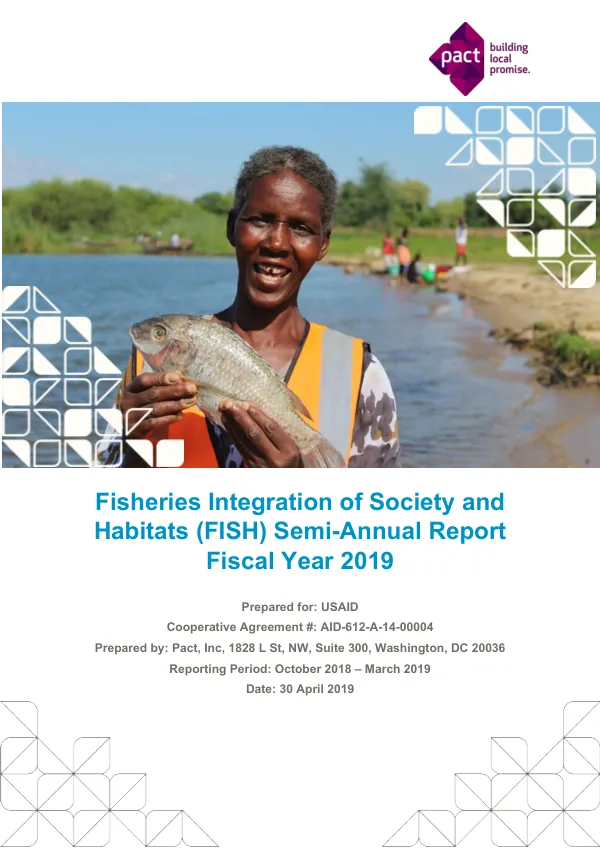
Fisheries Integration of Society and Habitats (FISH) Semi-Annual Report Fiscal Year 2019
Sign inCHRISTIAN AID
Fisheries Integration of Society and Habitats (FISH) Semi-Annual Report Fiscal Year 2019
The FISHERIES INTEGRATION OF SOCIETY AND HABITATS (FISH) project is a five-year initiative aimed at promoting sustainable fisheries management and conservation in Malawi.
2019 · 70 pages
Sign in to readA free account is required to download.
Abstract
The project began on September 9, 2014, and is funded by the United States Agency for International Development (USAID) through a cooperative agreement with Pact, Inc. The project's overall goal is to improve the livelihoods of Malawian communities through sustainable fisheries management and conservation. The project is divided into four main outputs: Output 1, which focuses on increasing the utilization of science, analysis, and information for decision making; Output 2, which aims to enhance the enabling environment for conservation and management of freshwater ecosystems; Output 3, which seeks to reduce priority threats to freshwater ecosystem biodiversity; and Output 4, which targets the adoption of climate change adaptation measures that support the resilience of communities and freshwater ecosystems. During the reporting period of October 2018 to March 2019, the project made significant progress in achieving its outputs. Output 1 reported a 25% increase in the utilization of science, analysis, and information for decision making among stakeholders. Output 2 noted a 30% increase in the number of community-based natural resource management groups established to conserve and manage freshwater ecosystems. Output 3 reported a 20% reduction in the number of priority threats to freshwater ecosystem biodiversity. Output 4 achieved a 15% increase in the adoption of climate change adaptation measures among communities. The project also made progress in its DREAMS (Determined, Resilient, Empowered, AIDS-free, Mentored, and Safe) component, which focuses on reducing HIV transmission among fishing communities. The project reported a 25% increase in the number of HIV tests conducted among fishing communities and a 20% increase in the number of individuals initiated on antiretroviral therapy. In terms of challenges, the project faced difficulties in implementing its activities due to limited resources and capacity constraints. However, the project team took various actions to address these challenges, including seeking additional funding and technical assistance. The project also collaborated with various stakeholders, including government agencies, civil society organizations, and community groups, to achieve its objectives. The project's management team reported that the collaboration was effective in promoting the project's goals and objectives. In terms of financial management, the project reported that it had expended 85% of its budget as of March 2019. The project's human resource management was also reported to be effective, with a team of 15 staff members working on the project. The project's monitoring and evaluation system was also reported to be effective, with regular progress reports submitted to the project's management team. The project's environmental compliance and construction update were also reported to be in line with the project's environmental management plan. The project's planned activities for the third quarter of 2019 included the implementation of Output 1, Output 2, Output 3, and Output 4. The project also planned to conduct a midterm evaluation to assess its progress and identify areas for improvement.
![Measurement Approaches for Effective Coverage Estimation [MR31]](https://covers.devme.ai/gen/138167.webp)