ENGENDERHEALTH
Fistula Care Plus: Key Achievements and the Way Forward to End Fistula
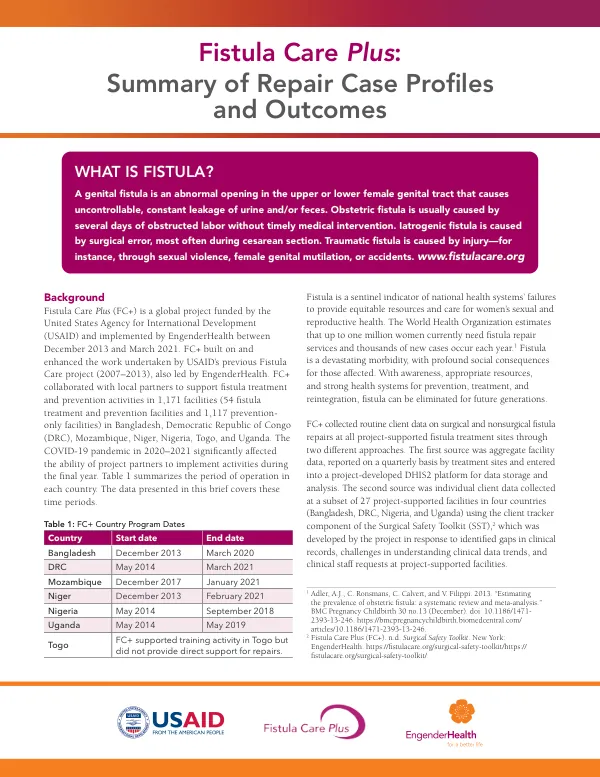
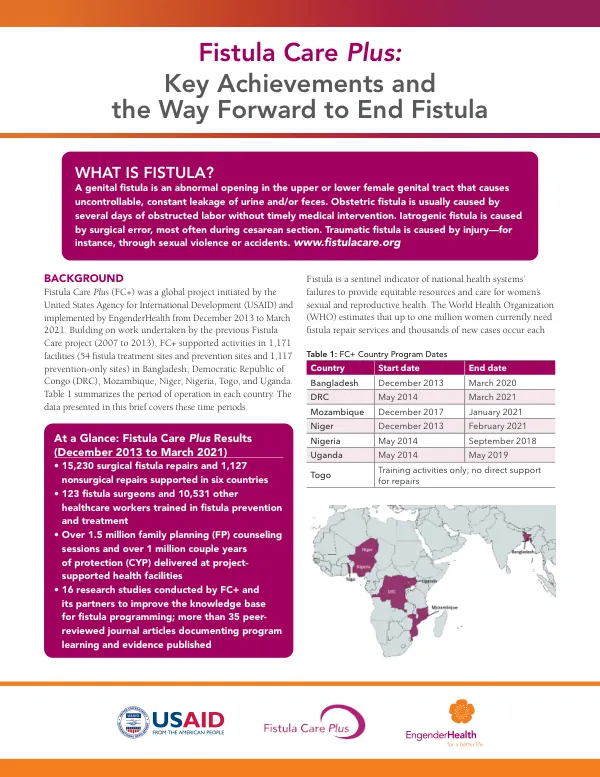
Fistula Care Plus (FC+) was a global project initiated by the United States Agency for International Development (USAID) and implemented by EngenderHealth from December 2013 to March 2021.
2021 · 12 pages
Sign in to readA free account is required to download.
Abstract
The project supported activities in 1,171 facilities across seven countries, including Bangladesh, Democratic Republic of Congo (DRC), Mozambique, Niger, Nigeria, Togo, and Uganda. FC+ aimed to strengthen health system capacity for fistula prevention, detection, treatment, and reintegration in priority countries in Sub-Saharan Africa and South Asia. A genital fistula is an abnormal opening in the upper or lower female genital tract that causes uncontrollable, constant leakage of urine and/or feces. Obstetric fistula is usually caused by several days of obstructed labor without timely medical intervention. Iatrogenic fistula is caused by surgical error, most often during cesarean section. Traumatic fistula is caused by injury, such as through sexual violence or accidents. The World Health Organization (WHO) estimates that up to one million women currently need fistula repair services and thousands of new cases occur each year. Between December 2013 and March 2021, FC+ supported the provision of 15,230 surgical fistula repairs in six countries: Bangladesh, DRC, Mozambique, Niger, Nigeria, and Uganda. In 87% of these repairs, the fistula was successfully closed. FC+ also supported the training of 123 fistula surgeons and 10,531 other health workers in the skills required to prevent and treat fistula. The project worked to increase awareness of and support for nonsurgical fistula treatment, which is appropriate for a proportion of fistulas, particularly recent fistulas and those caused by trauma. FC+ raised awareness about the challenge of iatrogenic fistula, which is caused by unintentional errors during surgical procedures, most often a cesarean section or hysterectomy. The project developed and introduced the Surgical Safety Toolkit (SST), an integrated package of clinical trackers and quality assurance checklists, in 27 facilities across four FC+ countries. The SST includes a client tracker for recording clinical outcomes of surgical and nonsurgical care for fistula, POP, and incontinence, as well as a surgical skills tracker to document the results of clinician training. FC+ also supported voluntary family planning (FP) counseling and services, which are essential to preventing unintended pregnancies and critical for fistula prevention. The project incorporated EngenderHealth's REDI Framework to support client-centered FP counseling, ensuring that fistula repair clients were offered FP counseling and methods to fit their needs. Counseling tools for fistula repair clients were developed and implemented, and over 1.5 million family planning counseling sessions and over 1 million couple years of protection (CYP) were delivered at project-supported health facilities.
Related documents