ENGENDERHEALTH
Fistula Care Plus: Summary of Repair Case Profiles and Outcomes
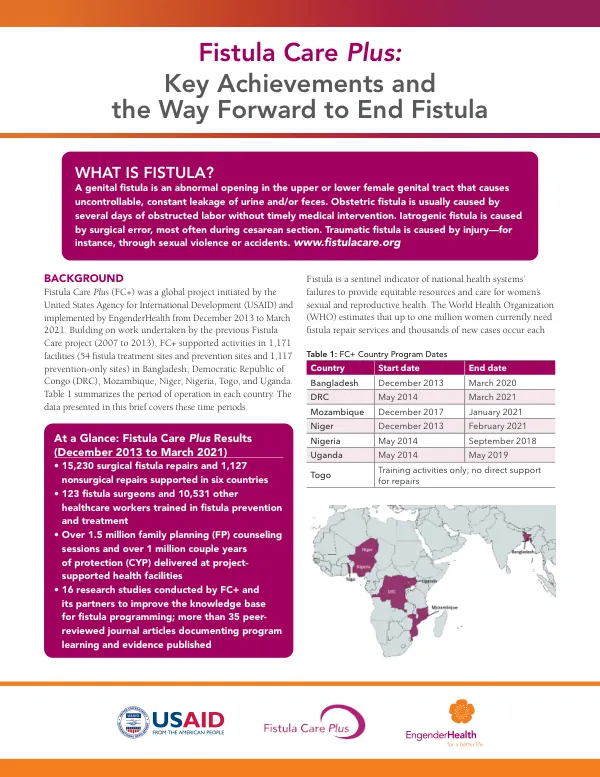
Fistula Care Plus (FC+) is a global project funded by the United States Agency for International Development (USAID) and implemented by EngenderHealth between December 2013 and March 2021.
2021 · 12 pages
Sign in to readA free account is required to download.
Abstract
The project built on and enhanced the work undertaken by USAID's previous Fistula Care project (2007-2013), also led by EngenderHealth. FC+ collaborated with local partners to support fistula treatment and prevention activities in 1,171 facilities in Bangladesh, Democratic Republic of Congo (DRC), Mozambique, Niger, Nigeria, Togo, and Uganda. Fistula is a sentinel indicator of national health systems' failures to provide equitable resources and care for women's sexual and reproductive health. The World Health Organization estimates that up to one million women currently need fistula repair services and thousands of new cases occur each year. Fistula is a devastating morbidity, with profound social consequences for those affected. With awareness, appropriate resources, and strong health systems for prevention, treatment, and reintegration, fistula can be eliminated for future generations. FC+ collected routine client data on surgical and nonsurgical fistula repairs at all project-supported fistula treatment sites through two different approaches. The first source was aggregate facility data, reported on a quarterly basis by treatment sites and entered into a project-developed DHIS2 platform for data storage and analysis. The second source was individual client data collected at a subset of 27 project-supported facilities in four countries (Bangladesh, DRC, Nigeria, and Uganda) using the client tracker component of the Surgical Safety Toolkit (SST), which was developed by the project in response to identified gaps in clinical records, challenges in understanding clinical data trends, and clinical staff requests at project-supported facilities. Between January 2014 and February 2021, FC+ partners provided 15,230 surgical and 1,127 nonsurgical fistula repairs at 55 health facilities in six countries: Bangladesh, DRC, Mozambique, Niger, Nigeria, and Uganda. During that period, a total of 26,247 women with severe incontinence symptoms sought fistula care services at FC+ supported sites. Of these women, 19,347 (74%) were diagnosed with fistula. Of those diagnosed, 18,029 (93%) were deemed medically eligible for surgical repair. FC+ supported the provision of 15,230 (85%) surgical fistula repairs of those deemed eligible. The causes of fistula varied widely between countries. Globally, 75.4% of diagnosed cases reportedly resulted from prolonged/obstructed labor (i.e., obstetric fistula); whereas 20% were identified as iatrogenic, 2.4% as traumatic, and the remaining 2.2% due to congenital conditions or cancer. Variation in diagnosed fistula etiology was great between countries. Bangladesh and DRC had significantly higher proportions of iatrogenic fistula (45% and 26%, respectively), in comparison with Mozambique, Niger, and Uganda where 90% or more of the fistula were classified as obstetric. DRC had the highest proportion of cases diagnosed with a traumatic fistula.
Related documents