DIMAGI, INC.
Annual Report: Fistula Care Plus FY1516
Fistula Care Plus, a collaborative project managed by EngenderHealth, achieved significant milestones during the third fiscal year (October 1, 2015 to September 30, 2016).
2016 · 3 pages
Sign in to readA free account is required to download.
Abstract
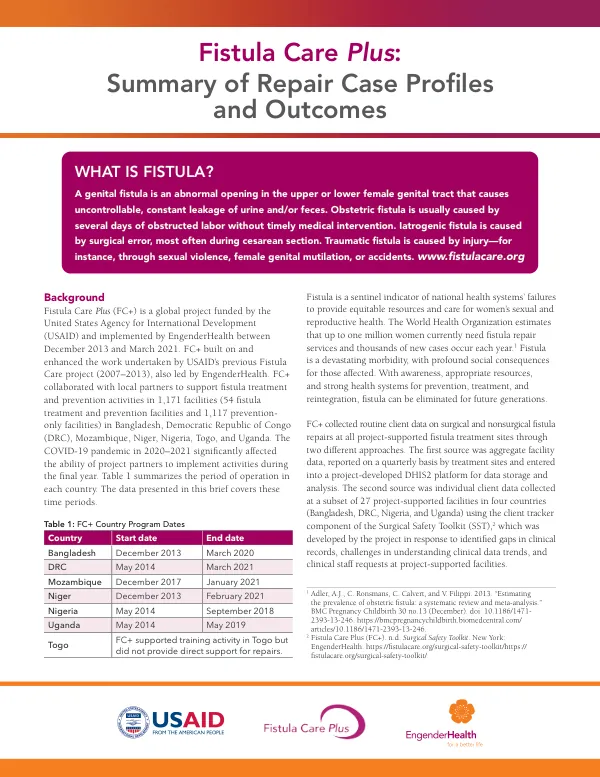
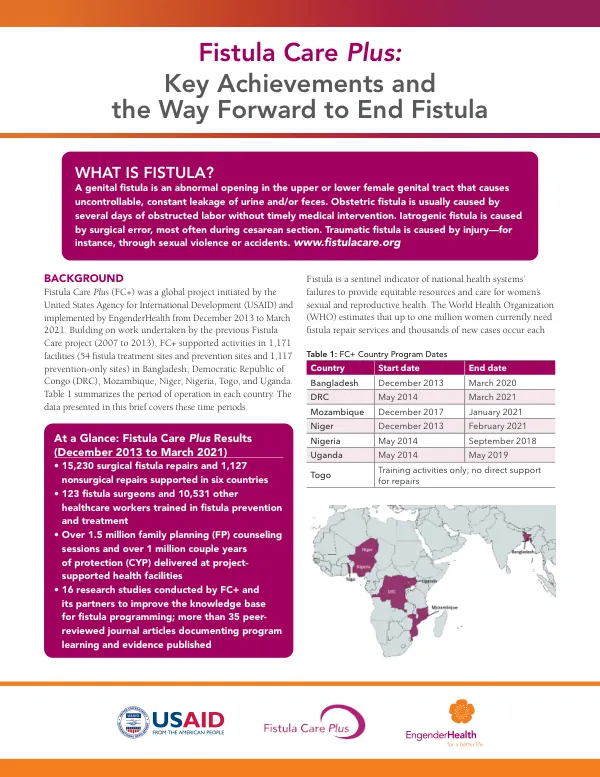
The project, supported by USAID, focused on fistula treatment and prevention services in six countries: Bangladesh, the Democratic Republic of the Congo, Niger, Nigeria, Togo, and Uganda. Additionally, USAID provided bilateral funding for fistula activities in six other countries: the Democratic Republic of the Congo, Ethiopia, Guinea, Mali, Pakistan, and Tanzania. Key accomplishments during this period included the launch of the Fistula Community of Practice (FCoP), which aimed to strengthen the enabling environment for fistula prevention and treatment. The project also supported the International Day to End Obstetric Fistula (IDEOF) celebrations in five countries, provided technical guidance to the Bangladesh Ministry of Health for the Bangladesh Maternal Mortality and Morbidity Survey, and conducted a landscape review of national fistula strategies in ten countries. The project also made significant progress in enhancing community understanding and practices related to fistula prevention and treatment. A total of 679 community volunteers and educators were trained to raise awareness about fistula prevention and repair, and 10,393 community awareness-raising activities were conducted, reaching 6,538,530 participants. The project also trained and supported outreach activities of religious leaders and village committees in Uganda and Nigeria, and developed a new 4Q checklist for fistula screening in Bangladesh. Furthermore, the project reduced transportation, communications, and financial barriers faced by women in Nigeria and Uganda through formative research and the design of an intervention package. The project also supported the completion of a communications assessment study in Nigeria and the development of two draft study reports. In terms of strengthened provider and health facility capacity, the project supported 37 sites for fistula treatment and prevention activities, and 289 sites for prevention-only activities. The project also provided training to 16 surgeons in fistula repair and 1,414 health system personnel in non-surgical fistula repair and prevention topics. Additionally, the project developed a POP integration pilot logic model, indicators, and implementation plan. The project also strengthened the evidence base through continued leadership in data collection and reporting using DHIS2, the implementation of a TERREWODE study on psychosocial reintegration of women with fistula, and the dissemination of research findings at various national and international forums. The project also collaborated with the Nigerian Ministry of Health to develop and pilot new HMIS tools.
Related documents