USAID DEC
Fixed-Day Static Approach: Informed Choice and Family Planning for Urban Poor in India
Sign inPOPULATION SERVICES INTERNATIONAL/DKT INTERNATIONAL
Fixed-Day Static Approach: Informed Choice and Family Planning for Urban Poor in India
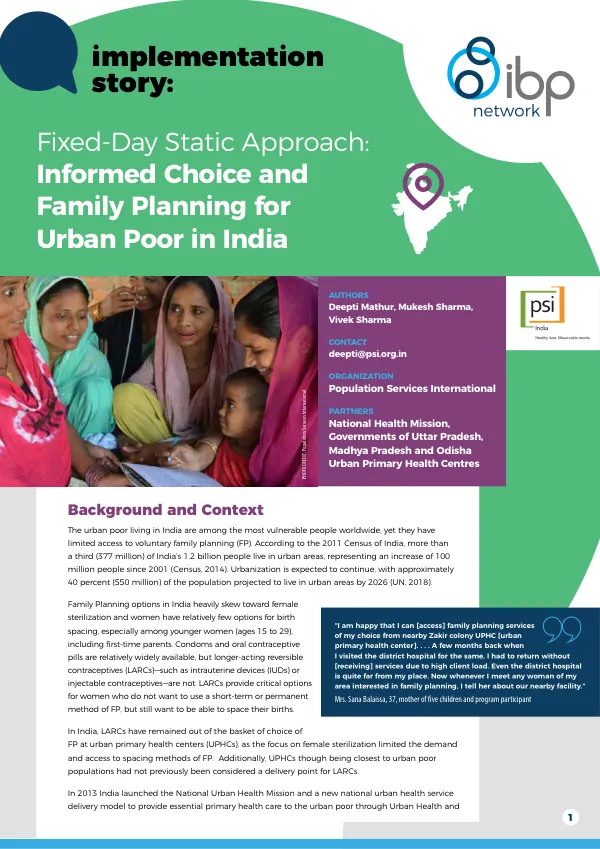
The Fixed-Day Static Approach for Informed Choice and Family Planning for Urban Poor in India was implemented by Population Services International's The Challenge Initiative for Healthy Cities (PSI-TCIHC) in partnership with the National Health Mission, Governments of Uttar Pradesh, Madhya Pradesh, and Odisha, and Urban Primary Health Centres.
2021 · 5 pages
Sign in to readA free account is required to download.
Abstract
The initiative aimed to increase access and availability of high-quality family planning (FP) services for urban poor women, particularly those residing in urban slums. The urban poor in India face significant challenges in accessing FP services, with limited options for birth spacing and a heavy reliance on female sterilization. The National Urban Health Mission prioritized the hiring and training of accredited social health activists/ASHAs, but UPHCs were poorly positioned to introduce longer-acting reversible contraceptives (LARCs). To address this gap, PSI-TCIHC adapted the fixed-day services approach, which was demonstrated by the Urban Health Initiative, to include a broader mix of birth-spacing methods at UPHCs. The Fixed-Day Static (FDS) approach ensures the availability of human resources and supplies for a wide variety of FP methods, including IUD kits, injectables, condoms, oral contraceptive pills, and weekly pills, at UPHCs during widely publicized fixed days and times. ASHAs play a central role in identifying, counseling, and directing women to UPHCs when the availability of FP methods is assured. The approach also involves coaching ASHAs on informed choice counseling and how to prioritize households and clients during home visits. Implementation of the FDS approach revealed that ASHAs had competing priorities and struggled to identify and prioritize FP clients from their multiple registers. PSI-TCIHC coached them on informed choice counseling and how to prioritize households and clients during home visits, devising a list of potential clients for follow-up, called an "FP due list." They were also coached to estimate FP need based on their lists and to note it for auxiliary nurse midwives to ensure timely procurement from the state and strengthen supply chain management. To demonstrate the feasibility of the FDS approach at UPHCs, select facilities were equipped in one of three ways: UPHCs with the required infrastructure, clinicians, and other human resources, and existing links with ASHAs for community mobilization for FDS days; UPHCs with poor infrastructure and no provider but available supplies; and UPHCs with human resources but no supplies such as IUD kits, and boilers. Over time, as UPHCs institutionalized regular FDS days and served increasing numbers of clients, they started procuring equipment for themselves using the budgets secured as part of PSI-TCIHC's advocacy efforts. According to the program management information system, FDS demonstrations at four facilities in Varanasi and Firozabad, cities in Uttar Pradesh, resulted in LARCs contributing between 61 percent to 95 percent of all FP methods during the month measured. As a result of their successes, UPHC medical officers in charge took more interest in the FDS approach. PSI-TCIHC made its data visible and UPHC medical officers in charge became advocates of FDS as a means to increase access to information and voluntary FP on both fixed days and routine days. The four implementation steps detailed below were key to the success of the FDS approach and its steps including facility preparation and screening of clients before providing an FP method build on the World Health Organization (WHO)'s Family Planning: A Global Handbook for Providers. The steps include: 1. Facility preparation: UPHCs were equipped with the necessary infrastructure, clinicians, and other human resources to provide high-quality FP services. 2. Screening of clients: Clients were screened before providing an FP method to ensure that they were eligible and had made an informed choice. 3. Provision of FP methods: UPHCs provided a wide variety of FP methods, including IUD kits, injectables, condoms, oral contraceptive pills, and weekly pills, during widely publicized fixed days and times. 4. Follow-up and monitoring: ASHAs were coached on informed choice counseling and how to prioritize households and clients during home visits, and they were also coached to estimate FP need based on their lists and to note it for auxiliary nurse midwives to ensure timely procurement from the state and strengthen supply chain management. Today, 513 of 517 UPHCs in Uttar Pradesh, Madhya Pradesh, and Odisha are implementing the FDS approach, a benefit of using data for decision making.