FEWS NET
Food Assistance Outlook Brief
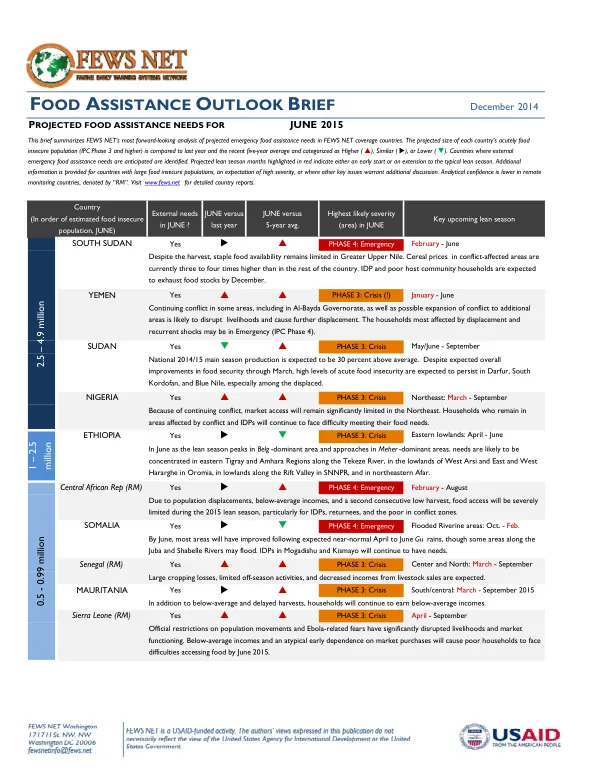
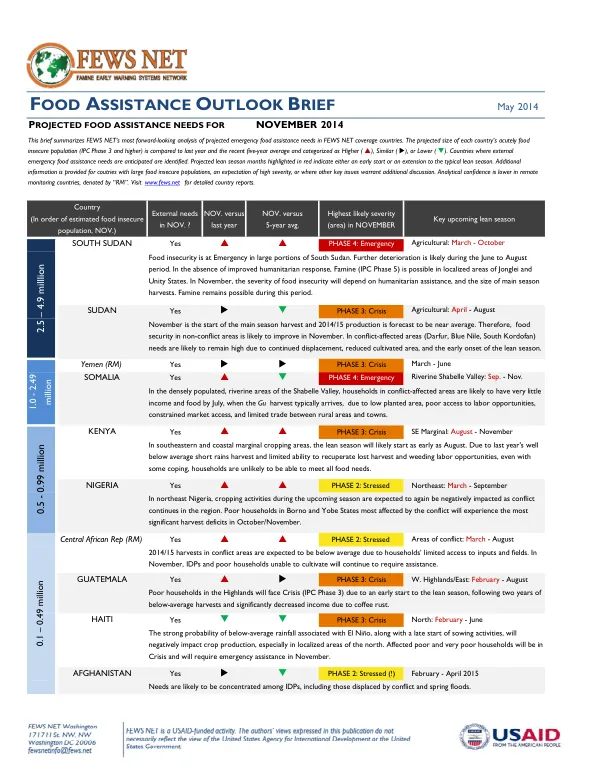
The projected food assistance needs for November 2014 are significant in several countries.
2014 · 4 pages
Sign in to readA free account is required to download.
Abstract
In South Sudan, the situation is critical, with a high likelihood of famine in localized areas of Jonglei and Unity States. The severity of food insecurity in November will depend on humanitarian assistance and the size of the main season harvests. In Sudan, food security is likely to improve in November due to near-average 2014/15 production, but needs are likely to remain high in conflict-affected areas. In Yemen, the lean season is expected to start early, and households in conflict-affected areas are likely to have very little income and food by July. In Somalia, poor households in Borno and Yobe States are expected to experience significant harvest deficits in October/November due to conflict. In the Shabelle Valley, households in conflict-affected areas are likely to have very little income and food by July due to low planted area, poor access to labor opportunities, constrained market access, and limited trade between rural areas and towns. The Sahelian zone is expected to experience a normal July to September Karan/Karma rains, which should improve outcomes. However, households in localized areas in the north and south that experienced a late onset of rains, periods of extended dryness, and early cessation of rains will face Crisis (IPC Phase 3) outcomes due to reduced food production and limited labor opportunities. In Ethiopia, the Meher cropping season is expected to be near average, but the Belg cropping season is likely to be below average. In Somalia, the cropping season is expected to be below average due to households' limited access to inputs and fields. In Kenya, the SE Marginal cropping area is expected to experience an early start to the lean season, and households are likely to face Crisis (IPC Phase 3) outcomes due to reduced food production and limited labor opportunities. The estimated acutely food insecure populations in November 2014 are significant in several countries. In South Sudan, the estimated population is less than 0.1 million, but the severity of food insecurity is high. In Sudan, the estimated population is 2.5-4.99 million, and the severity of food insecurity is moderate. In Yemen, the estimated population is 1.0-2.49 million, and the severity of food insecurity is moderate. In Somalia, the estimated population is 1.0-2.49 million, and the severity of food insecurity is high. In Nigeria, the estimated population is 1.0-2.49 million, and the severity of food insecurity is low. In Kenya, the estimated population is 0.5-0.99 million, and the severity of food insecurity is low. The IPC acute food insecurity phase descriptions are used to classify the severity of food insecurity in each country. The phases range from Minimal (IPC Phase 1) to Famine (IPC Phase 5). The severity of food insecurity is determined by the percentage of the population that is acutely food insecure, with higher percentages indicating higher severity. The estimated acutely food insecure populations in November 2014 are as follows: South Sudan (less than 0.1 million), Sudan (2.5-4.99 million), Yemen (1.0-2.49 million), Somalia (1.0-2.49 million), Nigeria (1.0-2.49 million), Kenya (0.5-0.99 million), CAR (0.5-0.99 million), Guatemala (0.1-0.49 million), Haiti (0.5-0.99 million), Afghanistan (0.5-0.99 million), Niger (0.1-0.49 million), and others.