AFRICARE, INC.
Food for Peace Fact Sheet Mali
The Food for Peace program in Mali aims to address food security concerns in the region.
2009 · 1 pages
Sign in to readA free account is required to download.
Abstract
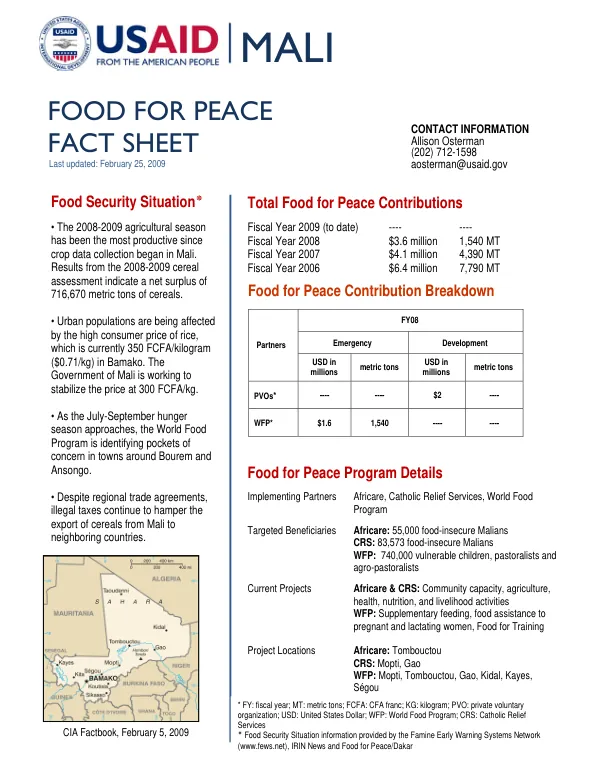
The 2008-2009 agricultural season has been the most productive since crop data collection began, with a net surplus of 716,670 metric tons of cereals. However, urban populations are being affected by the high consumer price of rice, which is currently 350 FCFA/kg ($0.71/kg). The Government of Mali is working to stabilize the price at 350 FCFA/kg. Africare, Catholic Relief Services, and the World Food Program are implementing partners in the Food for Peace program. Africare targets 55,000 food-insecure Malians, while Catholic Relief Services targets 83,573 individuals. The World Food Program focuses on 740,000 vulnerable children, pastoralists, and agro-pastoralists. The program includes community capacity, health, and livelihood activities, as well as supplementary feeding and food assistance to pregnant and lactating women. The program operates in several regions, including Mopti, Gao, Kayes, Ségou, and Tombouctou. In Mopti, the program focuses on supplementary feeding and food assistance, while in Gao, it targets vulnerable children and pastoralists. In Kayes and Ségou, the program aims to improve food security through community capacity building and livelihood activities. The program's budget for fiscal year 2009 is $3.6 million, with a total of 1,540 metric tons of food assistance. The program also includes emergency food assistance, with a focus on the July-September period, which is typically a time of concern for food security in the region. The program's goal is to improve food security and reduce hunger among vulnerable populations in Mali. The program's implementation is ongoing, with a focus on community capacity building, health, and livelihood activities. The program's success will depend on the effective implementation of these activities and the ability to address the root causes of food insecurity in the region.
Related documents