USAID DEC
Forecasting Wind and Solar Generation: Improving System Operations, Greening the Grid
Sign inARGONNE NATIONAL LABORATORY
Forecasting Wind and Solar Generation: Improving System Operations, Greening the Grid
Variable renewable energy (VRE) forecasting is a crucial tool for integrating wind and solar power into power systems.
2016 · 2 pages
Sign in to readA free account is required to download.
Abstract
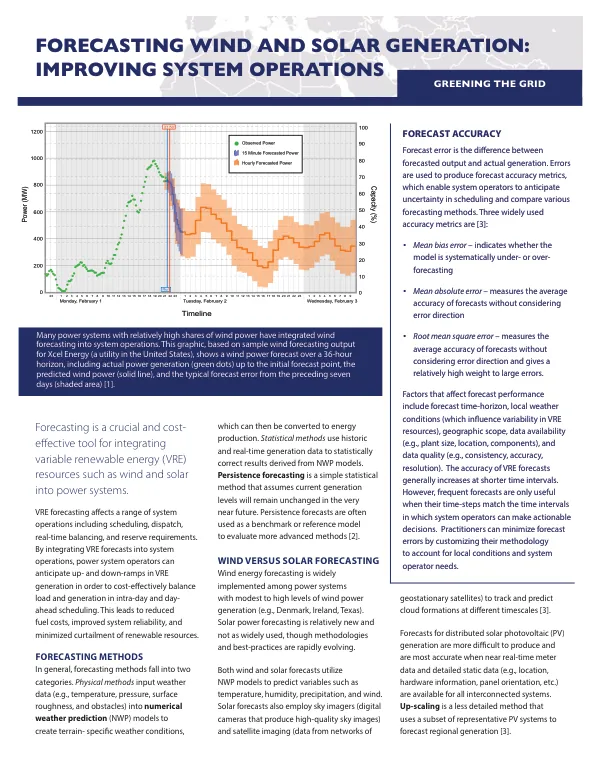
By accurately predicting VRE generation, power system operators can anticipate up- and down-ramps in VRE output, enabling cost-effective balancing of load and generation. This leads to reduced fuel costs, improved system reliability, and minimized curtailment of renewable resources. VRE forecasting methods fall into two categories: physical and statistical. Physical methods input weather data into numerical weather prediction (NWP) models to create terrain-specific weather conditions, which can then be converted to energy production. Statistical methods use historic and real-time generation data to statistically correct results derived from NWP models. Persistence forecasting is a simple statistical method that assumes current generation levels will remain unchanged in the near future. Wind energy forecasting is widely implemented among power systems with modest to high levels of wind power generation. Solar power forecasting is relatively new and not as widely used, although methodologies and best-practices are rapidly evolving. Both wind and solar forecasts utilize NWP models to predict variables such as temperature, humidity, precipitation, and wind. Solar forecasts also employ sky imagers and satellite imaging to track and predict cloud formations at different timescales. The accuracy of VRE forecasts generally increases at shorter time intervals. However, frequent forecasts are only useful when their time-steps match the time intervals in which system operators can make actionable decisions. Practitioners can minimize forecast errors by customizing their methodology to account for local conditions and system operator needs. Centralized VRE forecasting is widely considered a best-practice approach for economic dispatch. Administered by the balancing authority or system operator, centralized forecasts provide system-wide forecasts for all VRE generators within a balancing area. Decentralized VRE forecasting, administered by individual plant operators, provides plant-level information to help inform system operators of potential transmission congestion due to a single plant's output. Integrating VRE forecasts into energy and market management systems improves efficiency of system operations at various timescales. Day-ahead forecasts provide hourly power values for three to six days ahead, used in the scheduling process to help avoid costs and inefficiencies due to unnecessary starts and stops of thermal generators. Intra-day forecasts typically provide power values with frequent time steps up to six hours ahead, used in real-time dispatch and market-clearing decisions. System operators can procure forecasts from third-party vendors or meteorological research institutions, or they can develop in-house forecasts. Integrating VRE forecasts with real-time system operations requires advanced information technology, standardized data requirements, and certification for forecast-relevant data. Control center staff may require additional training on VRE plant models and new decision support tools for integrating VRE forecasts in dispatch decisions. The National Renewable Energy Laboratory (NREL) provides technical assistance to energy system planners, regulators, and grid operators to overcome challenges associated with integrating variable renewable energy into the grid. Greening the Grid is supported by the U.S. Government's Enhancing Capacity for Low Emission Development Strategies (EC-LEDS) program, which is managed by the U.S. Agency for International Development (USAID) and Department of State with support from the U.S. Department of Energy, U.S. Environmental Protection Agency, and other organizations.
Related documents