LANDESA
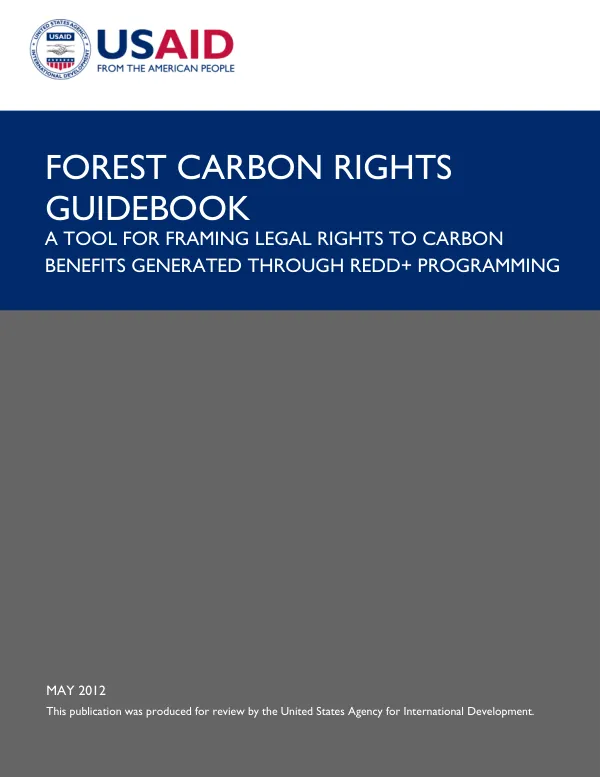
Forest Carbon Rights Guidebook
Forest carbon rights are a critical component of reducing emissions from deforestation and forest degradation (REDD+).
2012 · 37 pages
Sign in to readA free account is required to download.
Abstract
Deforestation is a leading source of carbon dioxide emissions, accounting for an estimated 12% to 17% of global greenhouse gas emissions, and over 90% of national emissions in many developing countries. Reducing deforestation and enhancing forest carbon stocks is crucial to mitigating the impacts of global climate change. Reducing emissions from deforestation and forest degradation is an emergent international mechanism aimed at increasing forest-based carbon sequestration by providing developing countries with financial incentives to protect and better manage their forest carbon stocks. Forest carbon stocks represent a new and poorly defined asset with unclear linkages to the rights associated with the resources that store the carbon and the land on which those resources reside. This makes assigning rights to benefit from increased sequestration and reduced emissions of carbon—or "carbon rights"—complicated and prone to opportunism. For REDD+ to be successful in incentivizing behavior that leads to reduced net emissions (while also avoiding harm and potentially creating benefits to forest-dependent communities), the right to benefit from sequestered carbon and reduced emissions must be clearly delineated. The approach that individual countries take will depend on a number of factors, including the existing resource tenure situation in the country and the final shape of an international REDD+ system. The guidebook is designed to enable development practitioners and policy makers to cultivate a deeper appreciation of carbon rights, the challenges associated with them, and their implications for REDD+ programming. The guidebook lays out a process for considering who should be entitled to receive benefits associated with REDD+ activities and the nature of those rights in order to create the appropriate incentives. This process involves gaining a more nuanced understanding of property rights and situating carbon rights within this concept (Phase 1), assessing the relevant stakeholders in structuring REDD+ programs and their interests (Phase 2), identifying the appropriate beneficiaries—or carbon right holders—in order to cultivate the necessary incentives to meet REDD+ objectives (Phase 3), analyzing the tenure situation and assessing rights to carbon, forest resources, and land within both customary and statutory law (Phase 4), and laying out a series of options for framing carbon rights in law that might be appropriate depending on the outcomes of the analysis of REDD+ stakeholders, potential beneficiaries, and the tenure situation (Phase 5). The guidebook provides analysis of the tenure situation and guidance on assessing rights to carbon, forest resources, and land within both customary and statutory law, particularly as these relate to the identified beneficiaries. Such analysis is designed to enable practitioners to establish where gaps, weaknesses, and conflicts exist in defining and structuring carbon rights to achieve REDD+ objectives. The guidebook lays out a series of options for framing carbon rights in law that might be appropriate depending on the outcomes of the analysis of REDD+ stakeholders, potential beneficiaries, and the tenure situation. Trade-offs associated with different alternatives for assigning carbon rights are discussed, and measures that might accompany legal reforms are also provided. The logical progression of the guidebook is outlined in Figure 1, which frames the process as a series of analytical steps. The guidebook aims to assist practitioners to identify options for framing carbon rights in law that will yield positive outcomes for the environment and local communities. Ultimately, the guidebook seeks to cultivate a deeper appreciation of carbon rights and their implications for REDD+ programming, enabling development practitioners and policy makers to make informed decisions about the assignment of carbon rights.
Related documents