TETRA TECH ARD, INC.
Forest & Land Fires Impact Study in Katingan-Kahayan Landscape
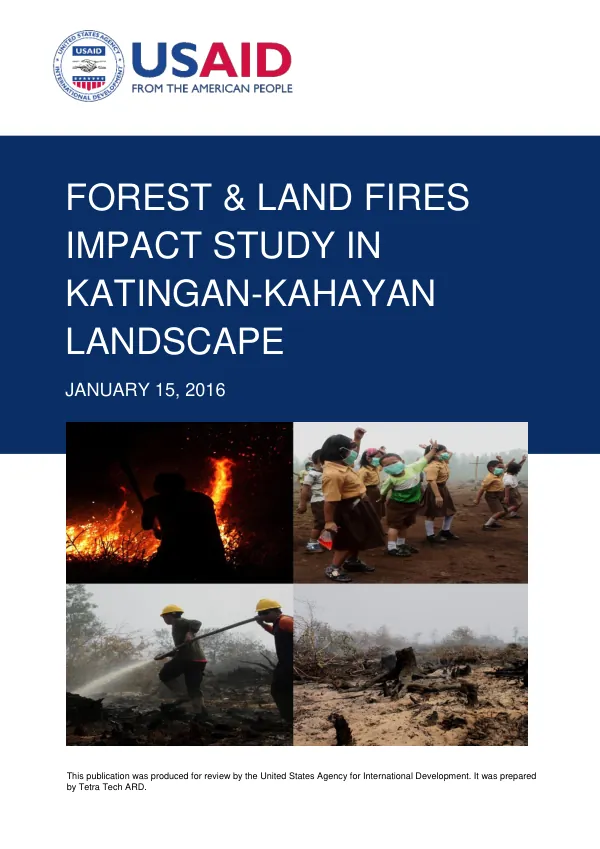
The Katingan-Kahayan Landscape in Central Kalimantan was one of the worst affected areas in Indonesia during the 2015 fire and haze crisis.
2016 · 33 pages
Sign in to readA free account is required to download.
Abstract
The crisis had a significant impact on the livelihoods of households in the area, with widespread negative effects on the economy, health, and education. A total land area of 304,113 hectares burned in the Katingan-Kahayan Landscape, resulting in significant economic losses. The research team estimated that the economic loss from burned rubber plantations was approximately $60,243 (IDR 821.65 million). Additionally, there was a 40% production loss in non-burned plantation/agricultural land. The impact on household incomes was severe, with 75% of households experiencing a negative effect. The crisis also led to a significant increase in health-related expenditures, with a 207% increase reported. Furthermore, primary and secondary schools were closed due to the crisis, affecting the education of children in the area. The research team employed a mixed methodology approach, consisting of a quantitative survey and qualitative group discussions. The quantitative survey involved 390 respondents from 30 villages across three districts/municipality, while the qualitative component included six group discussions in six villages across the landscape. The study highlights the importance of LESTARI's Integrated Fire Management (IFM) approach in engaging with communities to raise awareness and understanding of the importance of managing and preventing fire. By supporting the development of informed constituencies, it is expected that communities will be able to more effectively engage on the fire issue through governance platforms such as the Multi-Stakeholder Forum. The crisis underscored the need for a "shared-burden" approach to fire management, which is a cornerstone of LESTARI's IFM approach. This approach aims to foster a transparent dialogue across stakeholders to develop commitments and work together to prevent and manage fires. The study's findings emphasize the need for continued support and engagement with communities to address the impacts of the 2015 fire and haze crisis. By working together, it is possible to develop effective strategies for preventing and managing fires, and to mitigate the negative impacts on livelihoods, health, and education. The Katingan-Kahayan Landscape is a critical area for conservation and sustainable development, and the study's findings highlight the importance of addressing the root causes of the fire and haze crisis. By supporting the development of informed constituencies and promoting a "shared-burden" approach to fire management, it is possible to reduce the risk of future fires and promote sustainable development in the area. The study's methodology and findings provide valuable insights into the impacts of the 2015 fire and haze crisis on households in the Katingan-Kahayan Landscape. The research team's use of a mixed methodology approach and the inclusion of qualitative group discussions provide a rich understanding of the crisis's impacts and the need for continued support and engagement with communities. The study's recommendations for addressing the impacts of the crisis and promoting sustainable development in the area are based on the research team's analysis of the data and the insights gained from the qualitative group discussions. The recommendations emphasize the need for continued support and engagement with communities, as well as the importance of promoting a "shared-burden" approach to fire management. Overall, the study provides a comprehensive understanding of the impacts of the 2015 fire and haze crisis on households in the Katingan-Kahayan Landscape. The research team's findings and recommendations highlight the need for continued support and engagement with communities to address the crisis's impacts and promote sustainable development in the area.