USAID DEC
Understanding the Drivers of Deforestation and the Policies Incentivizing Forest Conversion in Forest and Peatland in the Leuser Landscape
Sign inTETRA TECH ARD, INC.
Understanding the Drivers of Deforestation and the Policies Incentivizing Forest Conversion in Forest and Peatland in the Leuser Landscape
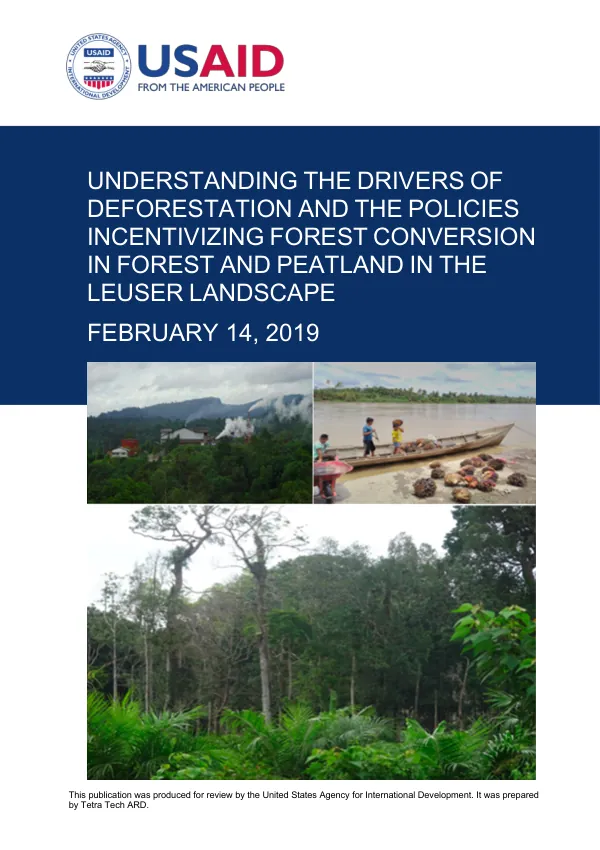
The Leuser Landscape, a region in Aceh Province, Indonesia, is home to a diverse array of ecosystems, including tropical forests, peat swamps, and coastal areas.
2019 · 42 pages
Sign in to readA free account is required to download.
Abstract
The Rawa Singkil Wildlife Reserve (WR), spanning three districts in Aceh, is designated as a Natural Conservation Area and Conservation Forest Management Unit. This reserve is the largest remaining intact peatland in Aceh and provides critical habitat for endangered species, such as the Sumatran orangutan. The reserve's unique ecosystems offer essential environmental services, including hydrological regulation, carbon storage, and prevention of methane emissions. However, the area is threatened by encroachment and oil palm development along its borders, which compromises the integrity of the ecosystem and negatively impacts local wildlife and livelihoods. The Wildlife Conservation Society (WCS), under the USAID LESTARI program, conducted an assessment to identify the major threats facing the Rawa Singkil WR and surrounding landscape. The analysis focused on the main causes of deforestation and the connections to commodity supply chains. Deforestation in the Rawa Singkil WR is primarily driven by oil palm expansion, with smallholder plantations and large-scale industrial operations contributing to the conversion of forested areas. Satellite imagery analysis reveals that deforestation patterns in the reserve are characterized by a high degree of fragmentation, with small patches of forest remaining amidst a sea of oil palm plantations. The oil palm supply chain is a significant driver of deforestation in the Leuser Landscape. Major buyers, including PT. Perkebunan Lembah Bhakti 2, source fresh fruit bunches (FFB) from mills in the Singkil landscape, which are often located near the Rawa Singkil WR. The mills' operations have been linked to deforestation and habitat fragmentation, highlighting the need for more sustainable practices in the palm oil industry. The report recommends approaches to mitigate the conversion pressures associated with palm oil production, including the implementation of sustainable agriculture practices, such as Good Agricultural Practices (GAP), and the promotion of certified sustainable palm oil (CSPO). Additionally, the report suggests engaging with palm oil supply chain stakeholders to address the root causes of deforestation and promote more sustainable land-use practices. The findings of this report provide a vision for the long-term sustainability of the Rawa Singkil WR and highlight the need for collaborative efforts to protect the integrity of the peatland ecosystem. The report's recommendations are consistent with the USAID LESTARI program's technical scope in supporting the Government of Indonesia to reduce greenhouse gas emissions and conserve biodiversity in carbon-rich and biologically significant forest and mangrove ecosystems. The Rawa Singkil WR is a critical component of the Leuser Landscape, providing essential ecosystem services and supporting biodiversity. The report's analysis and recommendations aim to inform policy and decision-making efforts to protect this unique ecosystem and promote sustainable land-use practices in the region.