USAID. MISSION TO PAKISTAN
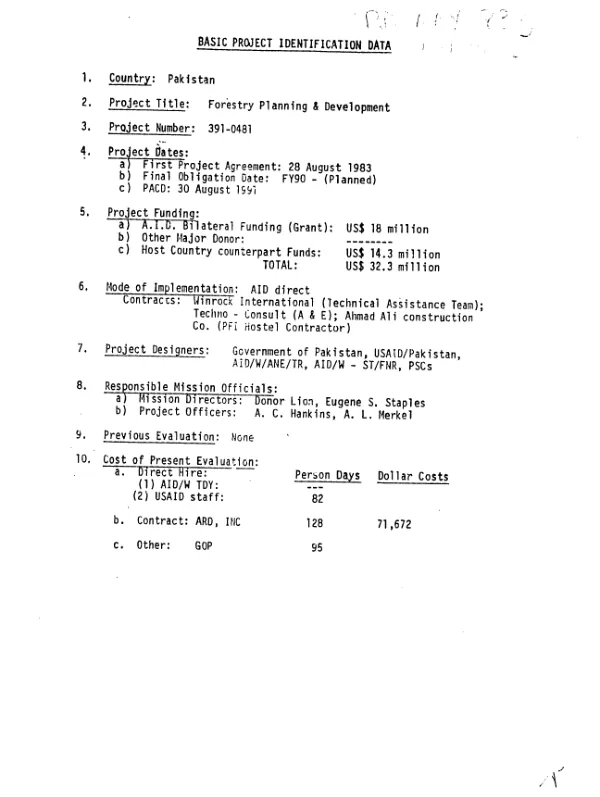
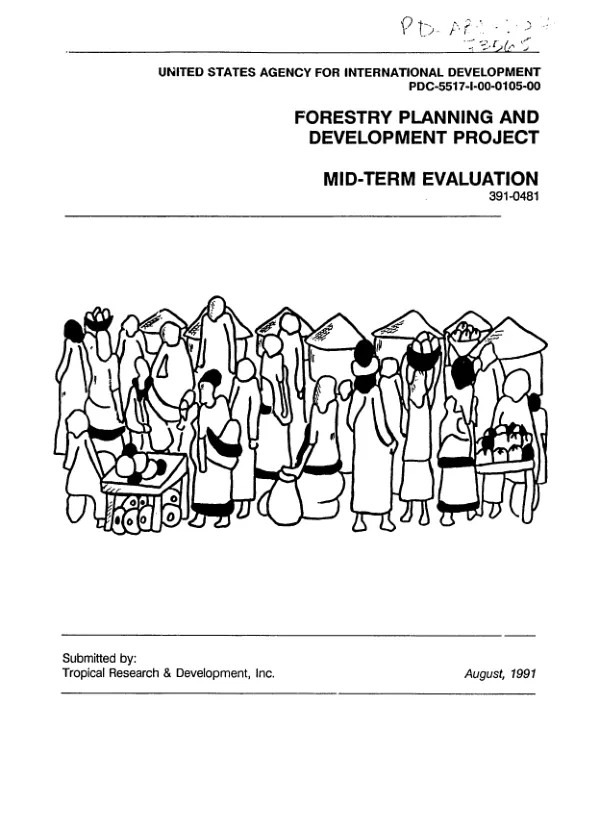
Forestry planning and development
This second midterm evaluation was completed in July 1991, 8 years after the project started.
1991
Sign in to readA free account is required to download.
Abstract
The project"s primary goal is to help Pakistan increase its energy supplies to achieve energy self-sufficiency. The secondary goal is to reverse the process of deforestation in Pakistan and to expand the extremely limited forest resource base. The primary purpose is to strengthen the capacity of institutions at the Federal, Provincial, and local levels. The secondary purpose is to demonstrate the economic, technical, and social feasibility of producing tree crops on privately owned farm and rangeland. The evaluation concluded that the farm forest program has been successful and people are planting trees, often on land converted from agriculture. Implementation of the private sector field nursery and plantation activity is successful, as is out-of-country training. The Data Base Cell, NGO, and Skardu area activities have not been implemented for want of timely approval of the Government of Pakistan PCI (the host-country equivalent to a Project Paper). The in-country training program has been partially installed. There is no farm-oriented research, as planned for in the project design. The strong emphasis on Eucalyptus trees diverges from Project Paper strategy, as does the orientation in favor of large land holders. This is partially due to: (1) the fast growing characteristic of Eucalyptus for early returns and (2) availability of more land with the larger landowners. However, smaller owners are also significant participants. The main lesson learned is that establishing a sustainable information infrastructure required to meet project objectives takes years. This complex process has only had a real productive life of 4 years out of the 8 planned. It would need to be extended in order to put into place sustaining activities. Pressler restrictions, however, drastically limit the options. Other lessons are as follows. (1) The project has become popular with farmers. (2) Originally oriented towards growing trees for fuelwood, the project has taken a turn towards the marketing of wood in the private sector. (3) Industrial users in particular have become interested in project activities. (4) NGO/PVO involvement should result in increased activity on a sustained basis. (5) Activities contribute to an overall environmental program and biodiversity improvement. The evaluators felt that: (1) efforts towards sustainability activities need to be made by extending the life of project to the extent permissible; (2) more training programs developed for farmers are needed; and (3) farmer-oriented research is needed, along with adoption of its findings.
Related documents