INTERNATIONAL ORGANIZATION FOR MIGRATION
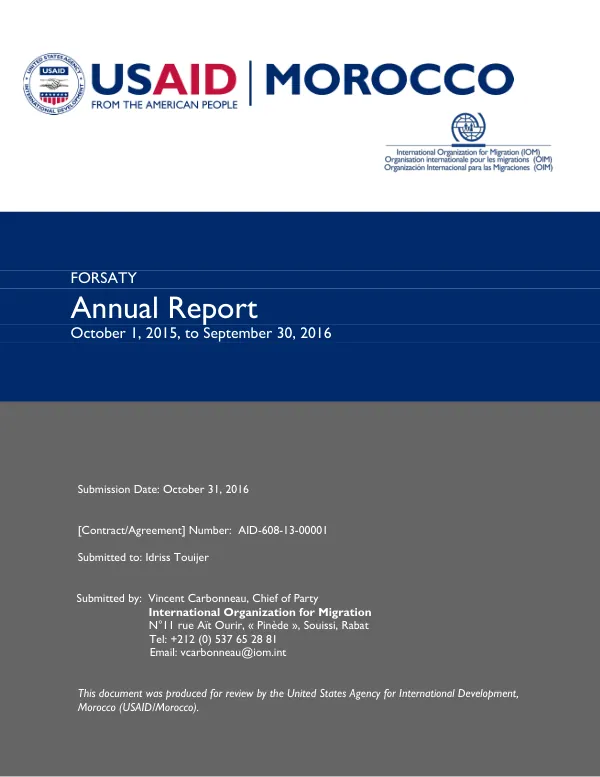
FORSATY FY2016 Annual Report to USAID/Morocco
FORSATY is a project aimed at preventing marginalized youth in peri-urban neighborhoods from being open to violent extremist messaging.
2016 · 70 pages
Sign in to readA free account is required to download.
Abstract
The project's primary objective is to empower youth to become full-fledged citizens in their neighborhoods and cities. To achieve this goal, FORSATY targets youth in six underserved urban neighborhoods in Tangier and Tétouan, where Islamic State recruitment cells are active. The project focuses on establishing and strengthening bonds between youth through youth-led activities, which aim to pull youth toward positive identification with their neighborhoods, cities, and institutions. Additionally, FORSATY seeks to guide youth toward life-paths that lead to productive adult life, including career and marriage. The project targets marginalized youth aged 10 to 25, including those who are very marginalized, unable or unwilling to seize opportunities, youth in school at risk of dropping out, and marginalized youth out of school with no diploma or prospects for socioeconomic integration. FORSATY actively pursues its goal through sectorial interventions that build youths' internal and external assets. Activities are implemented through Civil-Society-Organization (CSO) interventions in the education, vocational, and community sectors. The project's approach is designed to address the root causes of youth marginalization and provide them with the necessary skills and support to become productive members of society. The project's target areas are six dense and underserved urban neighborhoods in Tangier and Tétouan, where the pull of legitimate institutions is weak, leaving young people open to messaging and recruitment by violent extremist cells. By establishing and strengthening bonds between youth, FORSATY aims to create a sense of community and belonging, which can help to prevent the spread of violent extremist ideologies. FORSATY's approach is based on the understanding that marginalized youth require a comprehensive and multi-faceted response to address their needs and provide them with opportunities for social and economic integration. The project's sectorial interventions are designed to build youths' internal and external assets, including their education, vocational skills, and community engagement. The project's activities are implemented through a network of CSOs, which work closely with local communities to identify and address the needs of marginalized youth. The CSOs provide a range of services, including education and vocational training, community outreach and engagement, and social support. By working closely with local communities, FORSATY aims to create a sense of ownership and responsibility among community members, which can help to sustain the project's impact over time. FORSATY's impact is measured through a range of indicators, including the number of youth engaged in the project, the number of youth who have completed education and vocational training programs, and the number of youth who have been employed or started their own businesses. The project's evaluation framework is designed to assess the effectiveness of its interventions and identify areas for improvement. Overall, FORSATY is a comprehensive project that aims to prevent marginalized youth from being open to violent extremist messaging. By establishing and strengthening bonds between youth, providing them with education and vocational training, and engaging them in community activities, FORSATY seeks to empower youth to become full-fledged citizens in their neighborhoods and cities.
Related documents