COUNTER PART INTERNATIONAL
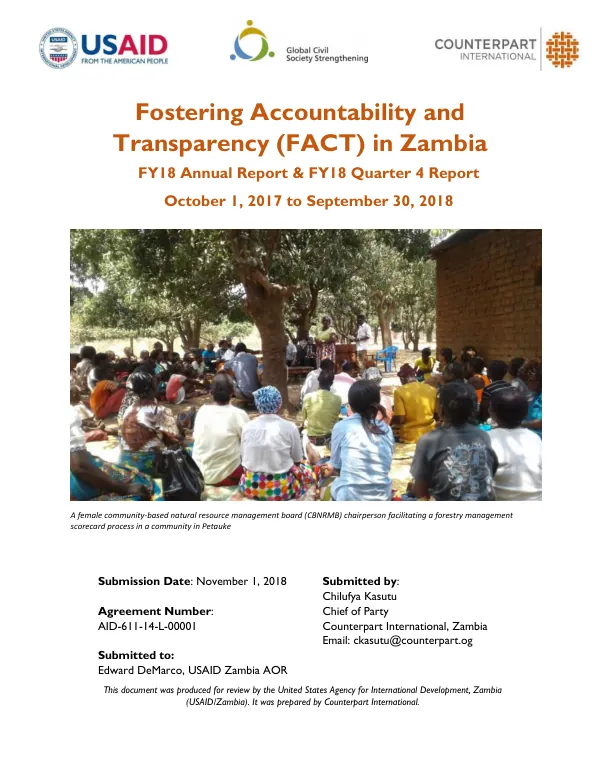
Fostering Accountability and Transparency (FACT) in Zambia
The Fostering Accountability and Transparency (FACT) program in Zambia aims to improve the enabling governance environment by increasing citizen demand for effective, transparent, and accountable service delivery.
2016 · 26 pages
Sign in to readA free account is required to download.
Abstract
The program is a 5-year initiative with a budget of $5.9 million, funded by the USAID Global Civil Society Leader with Associates Award. The program's goal is to strengthen the capacity of local Civil Society Organizations (CSOs) to enhance delivery and oversight of public service delivery in the education, health/HIV, sustainable rural livelihoods, and environment sectors. In the second quarter of FY16, FACT completed several ongoing processes, including finalizing the COMACO agreement, releasing a Request for Applications (RFA) for the second round of grants for CSO coalitions/networks, and reviewing submitted concept notes from the second round of grants. The program also organized a proposal development workshop, monitored FACT partners' implementation of grant activities, and coordinated a meeting with the FACT partners to identify issues emerging from their projects and areas of learning in line with FACT's learning framework. Counterpart, the implementing partner of FACT, organized and facilitated several trainings for local CSO partners, including an orientation on the Most Significant Change approach to monitoring and evaluation, Financial Management, and Gender and Social Inclusion training. Additionally, Counterpart initiated the formation of a Social Accountability Network, which brings together NGOs implementing Social Accountability projects across Zambia. The network met twice in the quarter, discussing areas of interest for learning and the impact of the current political context on social accountability projects. The political context in Zambia is characterized by an election year, which has led to some community members misinterpreting social accountability activities as being critical of the current government's service delivery. The development of the 7th National Development Plan is an ongoing process, with consultations with civil society and the lead CSO, Civil Society for Poverty Reduction (CSPR), engaged with the government in the process. Other CSOs, such as Christian Health Association of Zambia (CHAZ) and Zambia National Education Coalition (ZANEC), are leading on the thematic areas of Health and Education, respectively. The prices of mealie meal continue to increase, with some areas in Zambia reporting shortages of the product. The government has banned the export of maize and maize products to stabilize prices and preserve stocks, as this year's crop has been affected by the late and inadequate rainfall due to the El Nino effect. Poor harvests are expected to affect some communities in Eastern and Lusaka Provinces where FACT is operating. The government plans to issue a Statutory Instrument to ensure that measures taken to safeguard national food security are backed by a legal instrument and to curb illegal exportation of maize and mealie meal. The Ministry of General Education (MoGE) has been overhauling all policy documents in the Education Sector, including the National Education Policy, the Education Act, and the Operational Guidelines for Community Schools. Submissions from various stakeholders for the review of the Education Policy and the Community Schools Guidelines have been completed, while the last submissions from the districts for the Education Act were being reviewed in February through a process spearheaded by UNICEF. All policy documents are anticipated to be completed before the August 2016 elections.