USAID DEC
Fostering Accountability and Transparency (FACT) in Zambia Quarterly Report October 1 to December 31, 2018
Sign inCOUNTER PART INTERNATIONAL
Fostering Accountability and Transparency (FACT) in Zambia Quarterly Report October 1 to December 31, 2018
Fostering Accountability and Transparency (FACT) in Zambia is a quarterly report submitted to the United States Agency for International Development (USAID) Zambia.
2018 · 42 pages
Sign in to readA free account is required to download.
Abstract
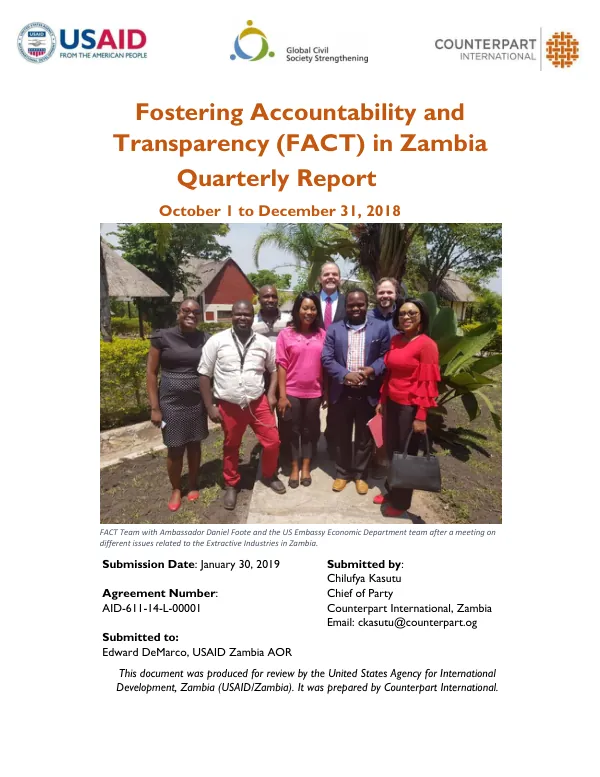
The report covers the period from October 1 to December 31, 2018, and was submitted on January 30, 2019. The FACT program aims to strengthen the capacity of local civil society organizations (CSOs) to play an oversight role in public service delivery. In the first quarter of FY19, FACT continued to support cross-sectoral advocacy networks and coalitions across the four targeted sectors. The program's work under objective one has shown great progress, with all eleven CSO partners fostering citizen engagement through various citizen platforms and methodologies. One significant accomplishment of FACT this quarter is ZINGO's work with the Ministry of Health (MoH) in the Nyimba district. ZINGO introduced the MoH-designed maternal, neonatal, and child health (MNCH) case management record in their nine target communities. This tool aims to ensure better and more effective monitoring of adherence to early Ante-Natal Care bookings and attendance, medically attended deliveries, and adherence to post-natal care. In the education sector, the Government of Zambia launched the National Education Sector and Skills Plan (NESSP) for 2017 to 2021. The national plan defines the strategy and focus for education development in the country. The launch of NESSP reflects the impact that ZANEC's advocacy influencing agenda has had on national-level education policy. COMACO leveraged Provincial Roundtable meetings to promote better management and accountability in the oversight of the Mukula tree conservation and trade. Through its Nyalugwe Community Conservation Area in Nyimba, COMACO collaborated with stakeholders in advocating for the establishment of the Luangwa Bridge Mukula checkpoint. The checkpoint would help address high levels of illegal production and trading in Mukula timber and unsustainable harvesting. ZINGO's consistent strengthening of its partnership and influencing government district planners and decision-makers in the health sector has seen tremendous improvements and changes in the way service providers operate in the Nyimba district. Notable among the accomplishments is the Commitment from the Nyimba District Commissioner to strengthen linkages and follow up with the Provincial Health Office (PHO) on action plans generated through the interface meetings and Nyimba District Health Office (DHO) pronouncement to facilitate ZINGO participation in the District Integrated Meetings (DIM). During this quarter, there was improved accessibility to health services in FACT-targeted facilities due to the completion of the maternity center in Chifukuzi, Nyimba. The average number of community members served increased from an average of 28 per day to an average of 42 per day. Other notable improvements reported by community members were increased health staff punctuality and responsiveness to community needs. Ambassador Foote's meeting with FACT EITI partners on October 30, 2018, in Solwezi was organized to discuss the partner's programs and examine the critical issues in the extractive sub-sector. After listening to the presentations and discussions, Ambassador Foote emphasized the importance of collaboration and coordination among stakeholders to address the challenges in the extractive sector. The FACT program has made significant progress in promoting government and citizen engagement, improving health services, and addressing the challenges in the extractive sector. The program's work under objective one has shown great progress, with all eleven CSO partners fostering citizen engagement through various citizen platforms and methodologies. The program's achievements in the education sector, health sector, and extractive sector demonstrate its commitment to promoting accountability and transparency in Zambia.