COUNTER PART INTERNATIONAL
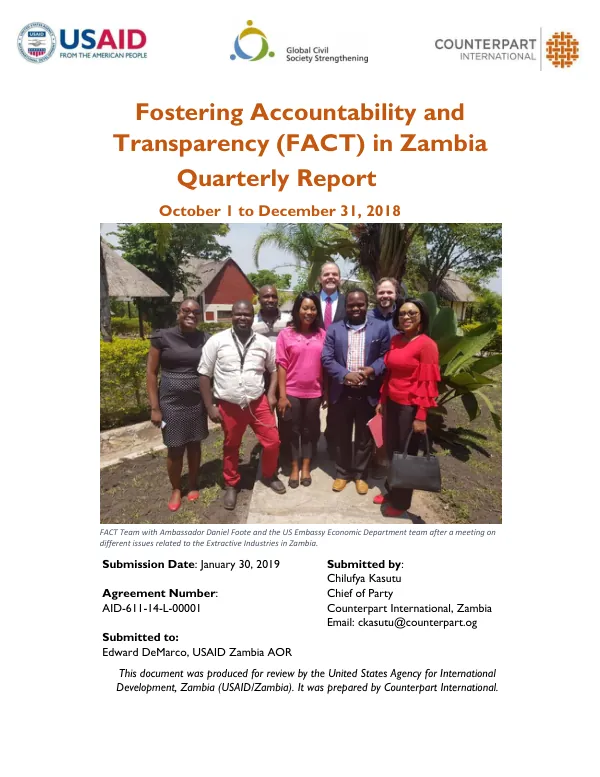
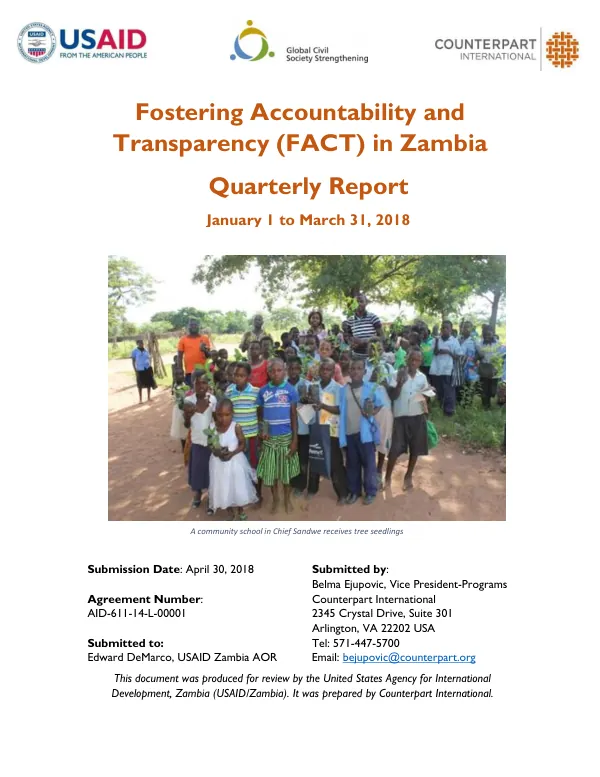
Fostering Accountability and Transparency (FACT) in Zambia
The Fostering Accountability and Transparency (FACT) in Zambia program, funded by the USAID Global Civil Society Leader with Associates Award, aims to improve the enabling governance environment in Zambia by increasing citizen demand for effective, transparent, and accountable service delivery.
2017 · 26 pages
Sign in to readA free account is required to download.
Abstract
The program, which began on September 30, 2014, and will conclude on September 29, 2019, has a budget of $5.9 million and a duration of five years. The program activities fall within two objectives: Objective 1, which seeks to strengthen the capacity of local Civil Society Organizations (CSOs) to enhance delivery and oversight of public service delivery in the education, health/HIV, sustainable rural livelihoods, and environment sectors; and Objective 2, which aims to improve engagement between citizens and government service providers in the same sectors to improve service delivery. In the first quarter of FY17, FACT completed modifications to sub-grant agreements to extend them for a further two years for five local CSOs. Community Markets for Conservation (COMACO) conducted District Advisory Management Committee meetings in Chipata, Lundazi, and Mambwe districts, creating a space for government departments, farmer cooperatives, and traditional leaders to discuss and agree on actions for conserving forests and wildlife. TALC rolled out the use of the community scorecard at Nampundwe Rural Health Facility, enabling service users and providers to score key aspects of the health services provided. This facilitated an understanding of the perspectives of both parties and led to recommendations for improving service provision. Reinforcing cross-sectoral advocacy networks and coalitions is a key component of the FACT project. In FY17 Q1, Counterpart signed sub-agreements with Civil Society for Poverty Reduction (CSPR) and Zambia National Education Coalition (ZANEC), paving the way for linking community and district-level accountability work to national-level dialogue and advocacy. FACT is also seeking to establish sub-agreements with the Zambia Alliance for Maternal, Neonatal, and Child Health (ZMNCH), Zambia Climate Change Network (ZCCN), and the Non-Governmental Coordinating Council (NGOCC). The government's development of an NGO policy is a critical element in the context of Zambia's civic space. A draft policy was presented at two consultations with CSOs in October and November 2016, and Counterpart participated in the first consultation, making recommendations for revisions to the draft policy. The draft policy currently upholds the practice of the NGO Act for NGOs to register with the Ministry of Community Development and Social Welfare (MCDSW). However, it fails to adequately describe measures that will be put in place to protect NGOs and provide an enabling environment. The government's long-awaited Access to Information Bill has yet to be tabled at parliament, and Counterpart's attempts to enquire from a range of CSOs failed to clarify the current status of the bill or how civil society is seeking to influence it. This is a concern as freedom of information is a building block for accountable governance. The government continues to develop the Seventh National Development Plan (7NDP), which has been delayed due to the electoral process in 2016. In November, Civil Society for Poverty Reduction (CSPR) launched a civil society shadow 7th National Development Plan, where civil society leads for various sectors provided priorities for each sector to promote Zambia's development.