USAID DEC
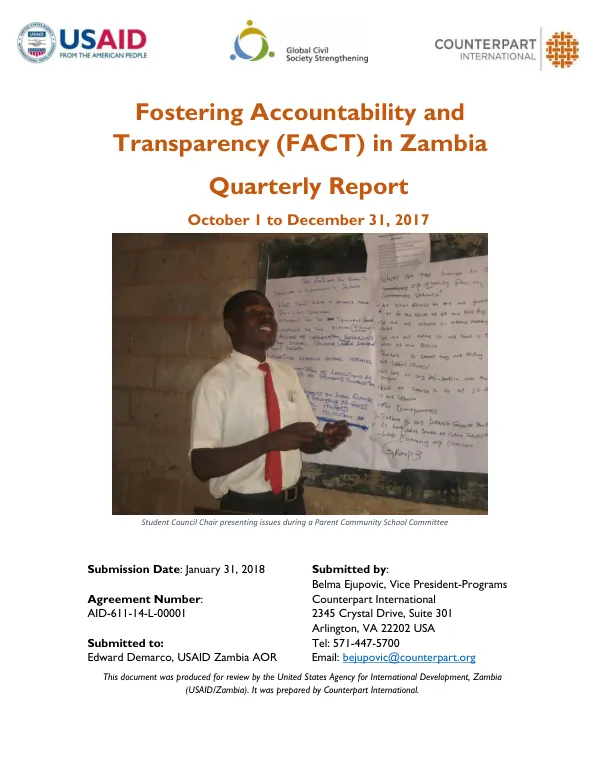
Fostering Accountability and Transparency (FACT) in Zambia Quarterly Report October 1 to December 31, 2017
Sign inCARITAS INTERNATIONAL
Fostering Accountability and Transparency (FACT) in Zambia Quarterly Report October 1 to December 31, 2017
The Fostering Accountability and Transparency (FACT) program in Zambia aims to improve the enabling environment for citizen engagement and demand for effective, transparent, and accountable service delivery.
2017 · 28 pages
Sign in to readA free account is required to download.
Abstract
The program focuses on engaging Civil Society Organizations (CSOs) to strengthen their capacity to deliver public services in the education, health, sustainable rural livelihoods, and environment sectors. To achieve this goal, FACT provides technical support to its nine partners, including the Civil Society for Poverty Reduction (CSPR), the Zambia National Education Coalition (ZANEC), and the Zambia Interfaith Networking Group (ZINGO). The program also conducts Participatory Organizational Development Assessments (PODAs) to identify capacity gaps and provide support to partners in addressing these gaps. During the reporting period, FACT continued to provide technical support to its partners, with a notable engagement by CSPR and ZANEC in advocating for the enactment of the Public Finance Management bill. The program also conducted several meetings with extractive industry stakeholders to inform the Extractive Industries Transparency Initiative (EITI) add-on component. The FACT program has a goal of improving the decentralization policy and the Seventh National Development Plan (7NDP). The program has a bi-annual meeting with partners to discuss the current state of the decentralization policy and the 7NDP. The program also has a transition plan in place to ensure continuity in program activities. The program's objectives are to strengthen the capacity of local CSOs to enhance delivery and oversight of public service delivery, and to improve engagement between citizens and service providers in the education, health, sustainable rural livelihoods, and environment sectors. The program's activities include conducting PODAs, providing technical support to partners, and engaging with stakeholders to inform the EITI add-on component. The program's indicators performance table shows that the program has made progress in achieving its objectives. The program's success story highlights the success of CSPR and ZANEC in advocating for the enactment of the Public Finance Management bill. The program's management and administration are managed by the Chief of Party, who is responsible for overseeing the program's activities. The program's financial management is overseen by the FACT team, which ensures that the program's budget is managed effectively and efficiently. The program's adaptive management approach allows it to respond to changing circumstances and make adjustments as needed. The program's MELP update highlights the progress made in achieving the program's objectives and the challenges faced by the program. The program's lessons learned highlight the importance of engaging with stakeholders and engaging with stakeholders to inform the EITI add-on component. The program's agreement management is overseen by the FACT team, which ensures that the program's activities are implemented in accordance with the agreement. The program's agreement management approach allows it to respond to changing circumstances and make adjustments as needed. The program's geographic focus is on the education, health, sustainable rural livelihoods, and environment sectors in Zambia. The program's timeframes are from September 30, 2014, to March 31, 2020. The program's recommendations highlight the importance of engaging with stakeholders and engaging with stakeholders to inform the EITI add-on component. The program's cross-cutting issues include the USAID Equality and Women's Empowerment Policy, which aims to promote gender equality and women's empowerment. The program's collaboration and knowledge sharing with other USAID activities highlight the importance of engaging with stakeholders and engaging with stakeholders to inform the EITI add-on component. The program's challenges include the need to strengthen the capacity of local CSOs to enhance delivery and oversight of public service delivery, and to improve engagement between citizens and service providers in the education, health, sustainable rural livelihoods, and environment sectors. The program's lessons learned highlight the importance of engaging with stakeholders and engaging with stakeholders to inform the EITI add-on component.
Related documents