USAID DEC
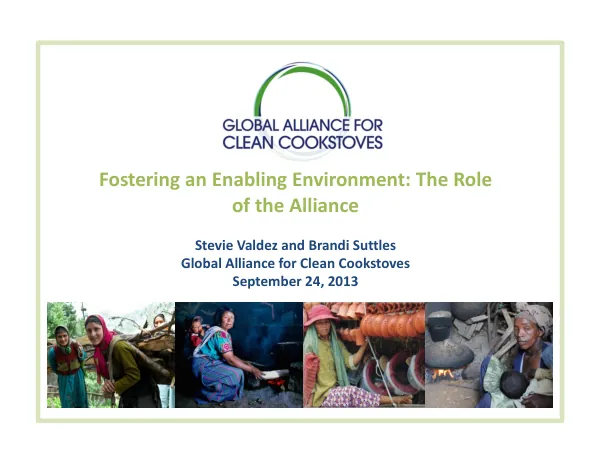
Fostering an Enabling Environment: The Role of the Alliance
The Global Alliance for Clean Cookstoves was established to address the significant health, environmental, and economic impacts of traditional cooking practices.
2013 · 14 pages
Sign in to readA free account is required to download.
Abstract
Approximately 3 billion people worldwide rely on traditional stoves, resulting in exposure to air pollution that is up to 100 times higher than the World Health Organization's recommended levels. This excessive exposure contributes to the deaths of 4 million people annually, with women and children disproportionately affected. The Alliance's research priorities from 2012 to 2020 focused on several key areas, including health, environment, and women's empowerment. The organization aimed to measure the impacts of clean cookstoves on child survival and development, noncommunicable diseases, and women's empowerment and livelihoods. Additionally, the Alliance sought to understand the opportunity cost impacts and women entrepreneur adoption impacts of clean cookstoves. The Alliance's strategic approach to addressing the cookstove sector involved catalyzing the sector, brokering partnerships, developing and promoting international standards, and championing the issue and advocating for change. The organization also aimed to coordinate sector knowledge and research, increase investments, and mobilize resources. To achieve these goals, the Alliance implemented a phased approach, with Phase 1 (2012-2014) focusing on establishing a foundation for the Alliance, Phase 2 (2015-2017) concentrating on scaling up efforts, and Phase 3 (2018-2020) focusing on catalyzing the sector and brokering partnerships. One of the key initiatives of the Alliance was the Spark Fund, which provided working capital to entrepreneurs and small businesses working on clean cookstove projects. The Ezylife case study illustrates the impact of the Spark Fund, which helped the company distribute 40,000 stoves in a single year and plan for an additional 70,000 stoves in the coming year. The Alliance also provided technical assistance to Ezylife to enhance its business plan and pitch deck, enabling the company to pitch to investors and leverage its success to increase scale. The Alliance's research priorities also included geospatial mapping of non-renewable fuel harvesting, which aimed to identify geographical regions with the highest mitigation potential due to the impact of traditional cooking practices on biomass harvesting and emissions. This research sought to link field-testing results with statistical and computational model-based results to predict global greenhouse gas emissions and facilitate a regional effort to better understand the impact of cookstove emissions.
Related documents