USAID DEC
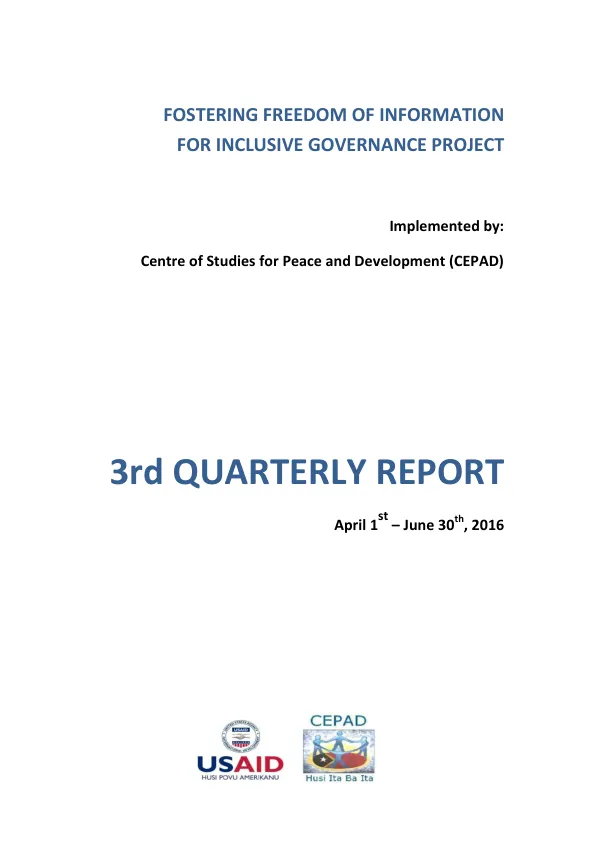
Fostering Freedom of Information for Inclusive Governance Project - 3rd Quarterly Report
Sign inLOCAL CIVIL SOCIETY ORGANIZATIONS
Fostering Freedom of Information for Inclusive Governance Project - 3rd Quarterly Report
The Fostering Freedom of Information for Inclusive Governance Project, implemented by the Centre of Studies for Peace and Development (CEPAD), aimed to promote transparency and accountability in the Government of Timor-Leste.
2016 · 16 pages
Sign in to readA free account is required to download.
Abstract
The project, supported by USAID, focused on empowering citizens to access public information and hold their leaders accountable. Public outreach and education were key components of the project, with the goal of establishing a well-informed Timorese society about the right to information. CEPAD developed a "Citizen's Manual: the Right to Know," which aggregated information related to Freedom of Information, including international conventions and commitments signed and ratified by the Government of Timor-Leste. The manual was used as the basis for a Training Module, which was employed in Training of Trainer sessions countrywide. The project also focused on advocacy campaigns led by Civil Society Organizations to motivate the adoption of concrete legislation and/or procedural reforms facilitating access to government information. While the Baseline Survey was yet to be implemented, pre and post-tests of all training sessions provided some good indicators. The project team was confident that a satisfactory Baseline survey would be undertaken in the near future. In terms of implementation, the project had experienced some delays due to changes in project staff. However, CEPAD had employed two new staff members, Mr. Elio Guimarães and Ms. Elsa Dos Santos, to support the project. The project had also completed the Training of Trainer sessions for various stakeholders, including the Anti-Corruption Commission, the Government of Timor-Leste, and Civil Society Organizations. The project had also made progress in developing a public information request system, with one request prepared and submitted by a civil society organization. However, the project team believed that this number would increase in the near future. The project had also conducted pre and post-tests of all training sessions, which provided some good indicators. In terms of gender integration, the project aimed to promote equal participation of men and women in the project activities. The project team had conducted a gender analysis of the project activities and had identified areas for improvement. The project had also established a gender focal point to ensure that gender considerations were integrated into all project activities. The project had also made progress in terms of management and personnel changes. The project team had experienced some changes in staff, including the departure of the Project Officer and the Project Coordinator. However, CEPAD had employed two new staff members to support the project. The project team was confident that the project would continue to make progress in the coming quarter. In terms of priorities for the 4th Quarter, the project team had identified several key activities, including the completion of the Baseline Survey, the implementation of the public information request system, and the continuation of the advocacy campaigns. The project team was confident that these activities would be completed on time and that the project would continue to make progress in promoting transparency and accountability in the Government of Timor-Leste.
Related documents