CARE
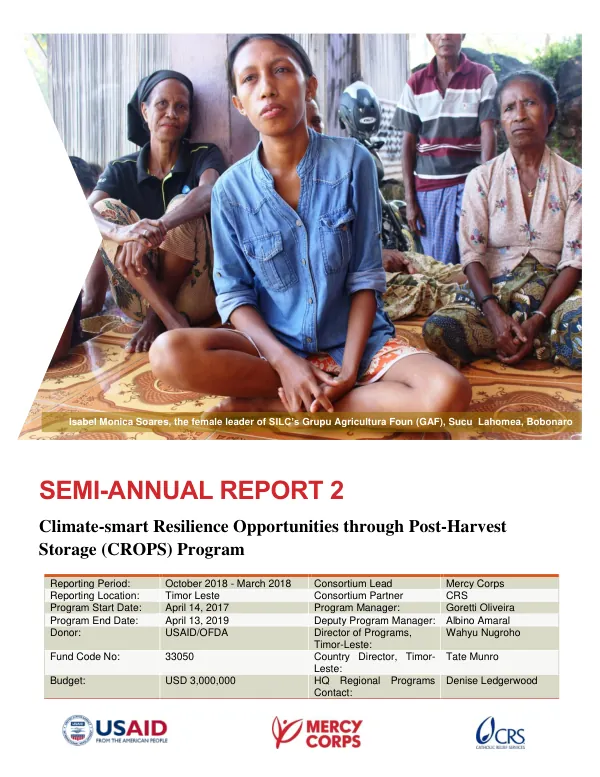
MERCY CORPS CROPS Semi-Annual Report 2: October 2017 – March 2018
The Climate-smart Resilience Opportunities through Post-Harvest Storage (CROPS) program is a program aimed at addressing chronic food insecurity, poverty, and vulnerability across Timor-Leste.
2018 · 10 pages
Sign in to readA free account is required to download.
Abstract
The program is led by Mercy Corps and Catholic Relief Services (CRS) and is funded by USAID/OFDA. The program's theory of change is that if income, food, and nutrition-insecure households vulnerable to climate shocks gain access to a combination of climate-smart, nutrition-sensitive agricultural production, marketing, and post-harvest storage skills and technologies, coupled with access to savings, credit, and skills and networks to effectively use them, they will become more resilient, achieve greater economic, food, and nutrition security, and enhance their ability to learn and perform better, thus strengthening their confidence and stability in the face of shocks and stresses. The program focuses on addressing the challenges facing subsistence farmers' access to and effective use of appropriate, climate-smart grain storage technologies, climate-smart vegetable production systems, and savings and internal lending communities (SILC). The program utilizes the Designing for Behavior Change (DBC) framework and information communication and technology (ICT) to add value to program implementation and quality. The program's goal is to increase the food, nutrition, and economic security of poor and vulnerable households in the face of climate shocks and stresses. The program has made significant progress in its first year, with over 80% of the population of Timor-Leste comprising subsistence farmers who often live in food, nutrition, and income insecurity. The program has recruited and strengthened the capacity of Field Agent Plus (FA+) to deliver program activities at the community level. FA+ are entrepreneurial service providers, mostly young female and male individuals, who deliver SILC services, promote climate-smart farming techniques, supply agriculture information, equipment, and inputs, and provide access to markets directly to targeted beneficiaries on a fee-for-service basis. The program has also promoted the SILC model to target households, with 241 SILC groups established, serving 4,582 households who are benefiting from savings, social fund services, and other benefits. The program has also implemented the Laboratorium To'os ba Aihan (TbA, Farmer Lab) model, a human-centered design process aimed at testing the efficacy of different grain storage technologies against traditional methods, raising awareness and support for grain storage systems, and gathering community input to select the best product and improve its design. The program has also started to layer other interventions, targeting mostly SILC members, including promotion of climate-smart agriculture techniques, such as keyhole garden, permagarden, trench gardening, and conservation agriculture, and household-level rainwater storage technologies. The program has seen a significant increase in the number of households with access to savings and loan services through SILC, with 17% more households than the program targets. The program has also identified promising, locally appropriate solutions for household grain and rainwater-harvesting storages, including double-layered 'j-bags' and pond liners, and is starting to see adoption of these solutions as they are made available by the FA+. The program has also seen a significant increase in the number of beneficiaries adopting climate-smart agriculture techniques and rainwater harvesting technologies, with 35% and 26% of the respective total targets, respectively. The program has also made significant progress in its first year, with over 56,000 households benefiting from the program, and over $3,000,000 spent on the program. The program has also seen a significant increase in the number of people benefiting from seed systems and agricultural input activities, with over 139,000 people benefiting from these activities. The program's geographic focus is on the entire nation of Timor-Leste, except for the Oecussi enclave. The program's sector focus is on agriculture and food security, with a specific focus on improving agricultural production and food security. The program's budget for all sectors is $3,000,000, and the program has spent over $700,000 on the program.