USAID DEC
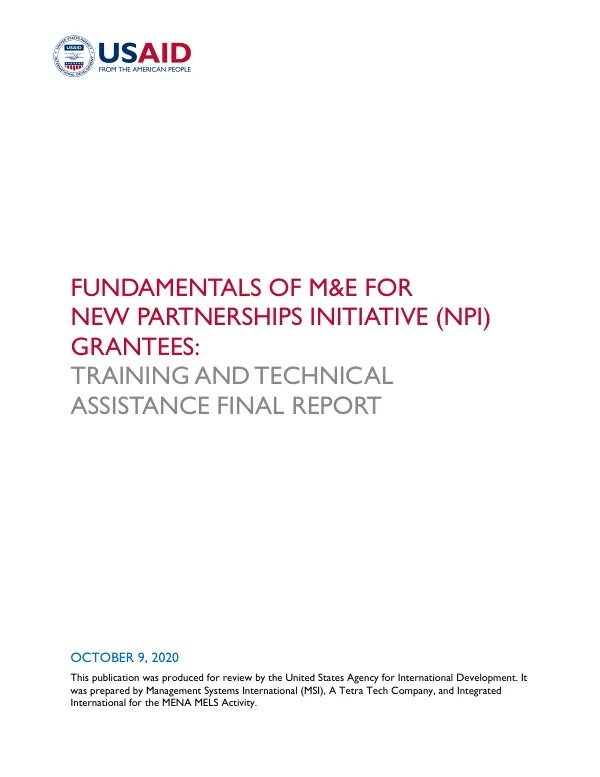
Fundamentals of M&E for New Partnerships Initiative (NPI) Grantees: Training and Technical Report
Sign inINTEGRATED INTERNATIONAL
Fundamentals of M&E for New Partnerships Initiative (NPI) Grantees: Training and Technical Report
The New Partnerships Initiative (NPI) in Iraq aimed to support six local non-governmental organizations (NGOs) that target minority groups.
2020 · 21 pages
Sign in to readA free account is required to download.
Abstract
The initiative was implemented under the USAID Middle East Bureau's Middle East and North Africa Monitoring, Evaluation and Learning Services Activity (MENA MELS) with Management Systems International (MSI). The training and technical assistance were provided to help the NGOs design and implement a Monitoring, Evaluation, and Learning (MEL) plan. The training covered all key aspects of a MEL plan and provided exercises and group work for participants to utilize what they learned. The training objectives included understanding the purpose and key components of the USAID MEL Plan, validating or developing the grantee's theory of change, refining or developing award-specific performance indicators, drafting or refining the monitoring plan, reviewing data collection requirements, and identifying and planning for next steps to complete the award's MEL Plan. The training was conducted by MSI's Jordan-based subcontractor, Integrated International, with facilitation provided by two experienced trainers, Mary Sayej and Hanna El Mufti, and additional support from MSI's Home Office. Thirteen participants attended the training, including USAID staff who attended selected training sessions. The training agenda included sessions on the New Partnership Initiative, M&E systems and components, theory of change, indicators, sustainability, monitoring plan, data collection and management, and evaluation plan. The participants worked in small groups to develop and review their theory of change, results framework, and monitoring plan. They also developed a 2-3-minute elevator pitch for each grant and presented it to the group. The training outcomes included the development of a MEL plan for each grant, identification of next steps for remote technical support, and a clear understanding of the purpose and key components of the USAID MEL Plan. The training also helped the participants to validate or develop their theory of change, refine or develop award-specific performance indicators, and draft or refine their monitoring plan. The training was successful in achieving its objectives, and the participants demonstrated a clear understanding of the MEL plan and its components. The training also helped to build the capacity of the NGOs to design and implement a MEL plan, which will enable them to effectively monitor and evaluate their programs and make data-driven decisions. The training team administered a pre-self-assessment to gauge the participants' experience with M&E, which helped to identify gaps and areas that needed strengthening. The training team also provided remote technical support for post-training monitoring, evaluation, and learning deliverables identified during the workshop. The capacity building needs assessment and tool are summarized in Annex A of the report. The report also includes a table outlining the final training agenda, which provides a detailed schedule of the training sessions and activities. Overall, the training and technical assistance provided to the six local NGOs in Iraq were successful in building their capacity to design and implement a MEL plan, which will enable them to effectively monitor and evaluate their programs and make data-driven decisions.
Related documents