USAID DEC
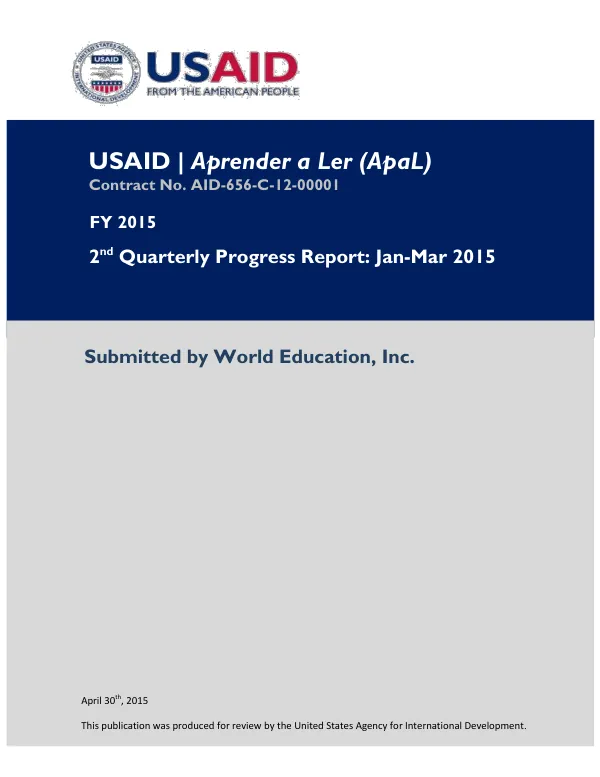
FY 2015 Q2 Progress Report: USAID | Aprender a Ler (ApaL) Project in Zambézia and Nampula Provinces
Sign inMINISTRY OF EDUCATION
FY 2015 Q2 Progress Report: USAID | Aprender a Ler (ApaL) Project in Zambézia and Nampula Provinces
The USAID | Aprender a Ler (ApaL) project aims to improve reading outcomes of students in grades 2 and 3 in over 1,000 urban and rural target schools in the Zambézia and Nampula provinces.
2015 · 61 pages
Sign in to readA free account is required to download.
Abstract
The project's overall goal is to increase the number of children reading in these provinces, aligning with the overall goal of the project and USAID's Education Strategy. To achieve this goal, the project provides key training, coaching, and technical assistance to improve the quality of basic education services, with a specific emphasis on improving early grade reading outcomes. Training and technical assistance are limited to the provinces of Zambézia and Nampula. The project's goals are closely aligned with the efforts of the Mozambican authorities to improve the quality of education as stated in the Strategic Plan for Education 2012-2016. The project focuses on two Intermediate Results (IRs): IR1, Improved QUALITY of reading instruction in grades 2-3 in targeted schools, and IR2, Increased QUANTITY of reading instruction in grades 2-3 in targeted schools. IR1 is further divided into two sub-IRs: Improved In-Service Teacher Training & Coaching and Increased Availability of Learning Materials for Students & Teachers in Grades 2-3. IR2 is further divided into one sub-IR: Strengthened School Management. The project is implemented using participatory and learning-by-doing approaches, based on World Education, Inc.'s extensive experience, to strengthen the technical and organizational skills of Local Education Institutions (LEIs) in line with established structures and processes to ensure sustainability. The project aims to hand over responsibility to local stakeholders, assuming capacity building is successful and LEIs demonstrate their ability to deliver and manage activities per USAID regulations. The project's geographic focus is on the Nampula and Zambézia provinces, with a total life of project funding of $19,464,644.00. The project duration is three years with an additional option year, and the start date is July 18, 2012. The project's overall goal is to improve reading outcomes of students in grades 2 and 3 in over 1,000 urban and rural target schools in the Zambézia and Nampula provinces. The project's progress during the second quarter of FY 2015 is summarized in the following sections. The period highlights include the completion of the Rapid School Assessment in Quelimane, which provided valuable information on the current state of reading instruction in the target schools. The key challenges faced during this quarter include the need to strengthen school management and increase the availability of learning materials for students and teachers in grades 2-3. The project's performance indicators are monitored and evaluated regularly to ensure that the project is on track to meet its goals and objectives. The project's activities during the second quarter of FY 2015 included the development and implementation of the teacher training and coaching model, the increase in availability of teaching and learning materials to teachers and students, and the raising of awareness about the importance of reading instruction. The project's collaboration with other donor projects is also an important aspect of its implementation. The project works closely with other stakeholders, including the Mozambican authorities, to ensure that the project's activities are aligned with the country's education strategy and that the project's goals and objectives are met. The project's financial information is also an important aspect of its implementation. The project's budget is managed carefully to ensure that the project's activities are implemented within the allocated budget. The project's financial information is reported regularly to USAID and other stakeholders to ensure transparency and accountability. Overall, the USAID | Aprender a Ler (ApaL) project is making progress towards its goals and objectives, and the project's activities are aligned with the country's education strategy. The project's collaboration with other stakeholders and its careful financial management are also important aspects of its implementation.
Related documents