MINISTRY OF EDUCATION
FY 2016 Q3 Progress Report: April - June 2016
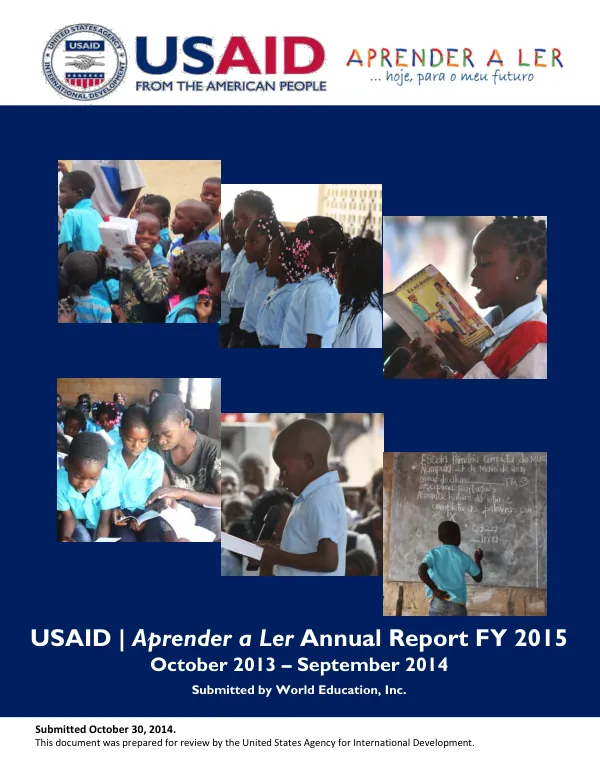
The USAID | Aprender a Ler (ApaL) project aims to improve reading outcomes of students in grades 1-3 in over 1,000 urban and rural target schools in the Zambézia and Nampula provinces.
2016 · 72 pages
Sign in to readA free account is required to download.
Abstract
The project's overall goal is to increase the number of children reading in these provinces, aligning with the USAID Education Strategy. To achieve this goal, the project provides training, coaching, and technical assistance to improve the quality of basic education services, with a focus on early grade reading outcomes. The project's goals are closely aligned with the Mozambican authorities' efforts to improve the quality of education, as stated in the Strategic Plan for Education 2012-2016. A key objective is to build the capacity of Local Education Institutions (LEIs) to implement and manage USAID|ApaL activities. The project will work towards full handover of responsibility to these local stakeholders, assuming they demonstrate the ability to take on this responsibility. The project is implemented using participatory and learning-by-doing approaches, based on World Education, Inc.'s (WEI) extensive experience. This approach aims to strengthen the technical and organizational skills of LEIs in line with established structures and processes, ensuring the project's sustainability. The project's success will be measured by the ability of LEIs to assume responsibility for activities, indicating the project's sustainability. The project's geographic focus is on the Nampula and Zambézia provinces, with a total life of project funding of $24,464,624.00. The project duration is four years, with an additional 2016 Option Period. The project started on July 18, 2012, and is expected to be completed by the end of the fourth year. The project's objectives are to improve reading outcomes, increase the availability of teaching and learning materials, and raise awareness about the importance of reading instruction. To achieve these objectives, the project has established several tasks, including institutional capacity building, reading reinforcement program, school director training and coaching, and monitoring and evaluation. The project has made significant progress in the third quarter of 2016, with key highlights including the development and implementation of teacher training and coaching models, the increase in availability of teaching and learning materials, and the raising of awareness about the importance of reading instruction. The project has also faced several challenges, including the need for additional short-term technical assistance and the need to improve the capacity of local stakeholders to assume responsibility for activities. The project's success stories include the implementation of school management in their own words, the use of "little books" to improve reading outcomes, and the building of the capacity of school directors. The project has also produced several videos showcasing the success of the project, including "Suraya Learns to Read" and "Edma Learns to Read."