MINISTRY OF EDUCATION
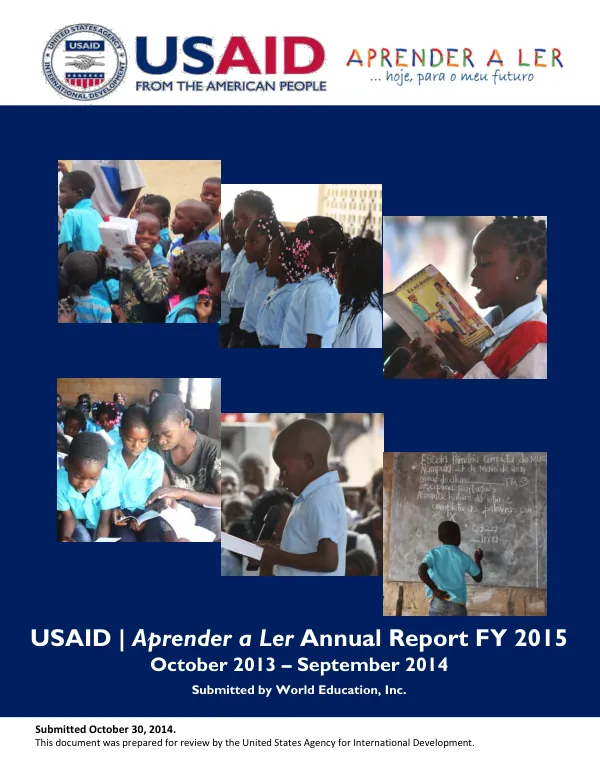
USAID | Aprender a Ler Annual Report FY 2015
The overall goal of the USAID | Aprender a Ler (ApaL) project is to improve reading outcomes of students in grades 2 and 3 in over 1,000 urban and rural target schools in the Zambézia and Nampula provinces.
2015 · 78 pages
Sign in to readA free account is required to download.
Abstract
The project focuses on improving the quality of basic education services, with a specific emphasis on improving early grade reading outcomes. Training and technical assistance are provided to improve the quality of reading instruction in grades 2-3 in targeted schools. To achieve this goal, the project provides key training, coaching, and technical assistance to Local Education Institutions (LEIs) to implement and manage USAID|ApaL activities. The project is implemented using participatory and learning-by-doing approaches to strengthen the technical and organizational skills of LEIs in line with established structures and processes to ensure sustainability. The project aims to build the capacity of LEIs to assume responsibility for activities, with a key indicator of project sustainability being the ability of these local stakeholders to take on this responsibility. The project focuses on two Intermediate Results (IRs): IR1. Improved QUALITY of reading instruction in grades 2-3 in targeted schools, and IR2. Increased QUANTITY of reading instruction in grades 2-3 in targeted schools. IR1 is further divided into two sub-IRs: Improved In-Service Teacher Training & Coaching, and Increased Availability of Learning Materials for Students & Teachers in Grades 2-3. IR2 is further divided into one sub-IR: Strengthened School Management. The project held a national project launch in Maputo in Year 1, which was attended by the U.S. Ambassador to Mozambique and the Minister of Education. Following this, similar events were held in each project province during Q1 of Year 2. The primary objective of these launches was to introduce the project to stakeholders and introduce the project's goals and objectives. Provincial Project Launches were also held to introduce the project to stakeholders and to provide an overview of the project's goals and objectives. Institutional Capacity Building is a key component of the project, with the goal of building the capacity of LEIs to implement and manage USAID|ApaL activities. The project has developed an Institutional Capacity Building Plan, which outlines the steps to be taken to build the capacity of LEIs. Rapid Organizational Assessments were conducted to assess the capacity of LEIs to implement and manage USAID|ApaL activities. Capacity Building Training for Local Education Institutions was provided to build the capacity of LEIs to implement and manage USAID|ApaL activities. The project has made significant progress in improving the quality of reading instruction in grades 2-3 in targeted schools. Improved In-Service Teacher Training and Coaching has been provided to teachers, resulting in improved reading outcomes for students. Increased Availability of Learning Materials for Students & Teachers in Grades 2-3 has also been achieved, with the provision of teaching and learning materials to schools. Community Engagement in Support of Reading has been strengthened, with the establishment of community-based reading programs. The project has also made significant progress in increasing the quantity of reading instruction in grades 2-3 in targeted schools. Strengthened School Management has been achieved, with the provision of training and technical assistance to school administrators to improve school management practices. The project has also established a Monitoring and Evaluation Plan to track progress towards the project's goals and objectives. The project has faced several implementation challenges, including delays in the provision of training and technical assistance to schools. However, the project has made significant progress in addressing these challenges and is on track to meet its goals and objectives. The project has also planned several activities for FY 2015, including the provision of training and technical assistance to schools and the establishment of community-based reading programs.