PLAN INTERNATIONAL USA
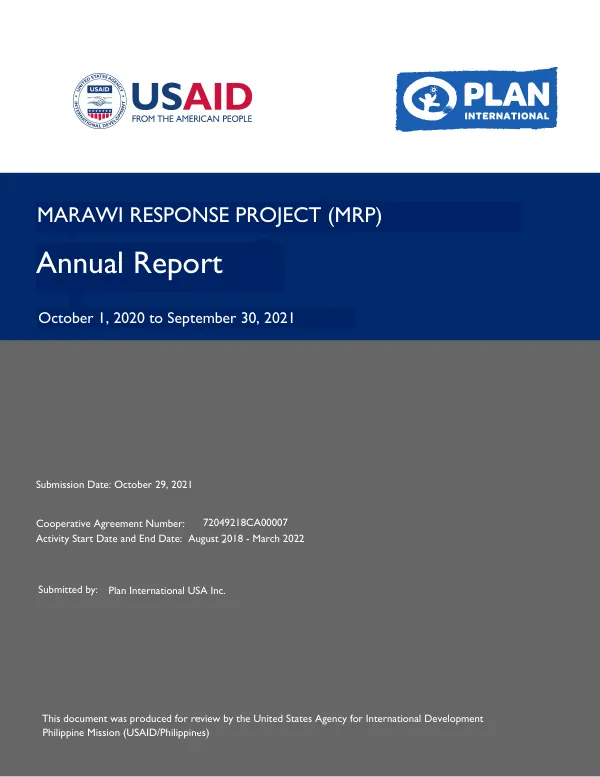
FY 2021 Annual Report/USAID/Philippines Marawi Response Project (MRP)
The Marawi Response Project (MRP) is a USAID-funded initiative aimed at supporting the recovery and resilience of internally displaced persons (IDPs) and host communities in Lanao del Sur, Marawi City, Lanao del Norte, and Iligan City.
2021 · 97 pages
Sign in to readA free account is required to download.
Abstract
The project began in August 2018 and is set to conclude in March 2022. Plan International USA Inc. serves as the prime implementing partner, with Ecosystems Work for Essential Benefits (ECOWEB) and Maranao People Development Center, Inc. (MARADECA) as subcontractors. The project's geographic coverage includes four cities and provinces in the Philippines, with a focus on promoting economic recovery, social cohesion, and community resilience. The project's objectives are aligned with USAID's goals of promoting self-reliance and economic growth in the region. The MRP's program implementation is structured around two intermediate results: improving economic conditions and strengthening social cohesion. To achieve these objectives, the project has established several outputs, including business recovery opportunities, employment opportunities, and livelihood opportunities. The project also focuses on promoting value chain priorities through demonstration farms and other activities. In terms of social cohesion, the project has implemented social cohesion grants and training programs for host and displaced communities. The project has also established a special initiative to respond to the COVID-19 pandemic, which has had a significant impact on the region. The project's cross-cutting themes include gender, youth development, and environmental compliance monitoring. The project has also prioritized coordination and program management, with a focus on grants delivery, procurement, personnel, and organization. The MRP's monitoring, evaluation, research, and learning (MERL) framework is designed to track progress toward the project's objectives and identify areas for improvement. The project has established several indicators to measure progress, including economic conditions, social cohesion, and community resilience. Despite the challenges posed by the COVID-19 pandemic, the project has made significant progress in achieving its objectives. The project has also identified several best practices and lessons learned, which will inform future programming in the region. The project's budget and cost share are outlined in the annexes, which provide a detailed breakdown of the project's financial resources and expenditures. The project's success stories are also highlighted in the annexes, which provide a snapshot of the project's achievements and impact. The MRP's communications strategy has been designed to promote the project's activities and achievements, with a focus on program visibility and assistance to program components. The project has also established a research and learning agenda, which includes several studies and assessments to inform future programming in the region. Overall, the MRP is a critical initiative aimed at supporting the recovery and resilience of IDPs and host communities in the Philippines. The project's focus on economic recovery, social cohesion, and community resilience is aligned with USAID's goals of promoting self-reliance and economic growth in the region.